All official European Union website addresses are in the europa.eu domain.
See all EU institutions and bodies
An official website of the European Union | How do you know?
Environmental information systems
EN


Adaptation at the EU level is guided by legislative and strategic policy documents that establish long-term objectives, define priorities for action and strengthen climate risk management and resilience across sectors and governance levels. Adaptation is embedded across a variety of EU policies and supported by knowledge platforms such as Climate-ADAPT.
Key messages
The European Climate Law establishes the EU’s legally binding objective of climate neutrality by 2050 and recognises the need to strengthen adaptation to climate change. It requires the EU and its Member States to ensure continuous progress in enhancing adaptive capacity, strengthening resilience and reducing vulnerability to climate change, in line with the Paris Agreement.
The EU Adaptation Strategy, adopted in 2021, sets out a long-term vision for a climate-resilient EU by 2050. It aims to make adaptation smarter, faster and more systemic, while strengthening international action. The strategy promotes better use of climate data and knowledge, the development and implementation of adaptation solutions, and the integration of climate resilience into policy and decision-making across sectors. It is a key pillar of the European Green Deal, aligns with the Paris Agreement, and contributes to the objectives of the Sendai Framework for Disaster Risk Reduction and the Sustainable Development Goals. The EU Mission on Adaptation to Climate Change supports regional and local authorities in accelerating the transition towards climate resilience.
Regional and sectoral policies play a key role in translating EU adaptation objectives into action. The EU Cohesion Policy, including the European Regional Development Fund (ERDF) and Interreg programmes, supports investments that strengthen climate resilience and help regions prepare for climate-related risks. Adaptation is also increasingly integrated into sectoral policies, including those addressing agriculture, water, energy, transport and health. The Climate-ADAPT Adaptation in Sectors pages provide further information on how climate adaptation is addressed across key EU policy areas.
The European Framework for Climate Resilience, expected in late 2026, aims to strengthen Europe’s preparedness for climate risks and improve coordination across relevant policy areas. It is intended to support a more coherent approach to climate resilience, bringing together adaptation, civil protection and financial risk management to help anticipate, prevent and manage the growing impacts of climate change and support the implementation of the EU Adaptation Strategy.
Why EU adaptation policy matters for climate change adaptation
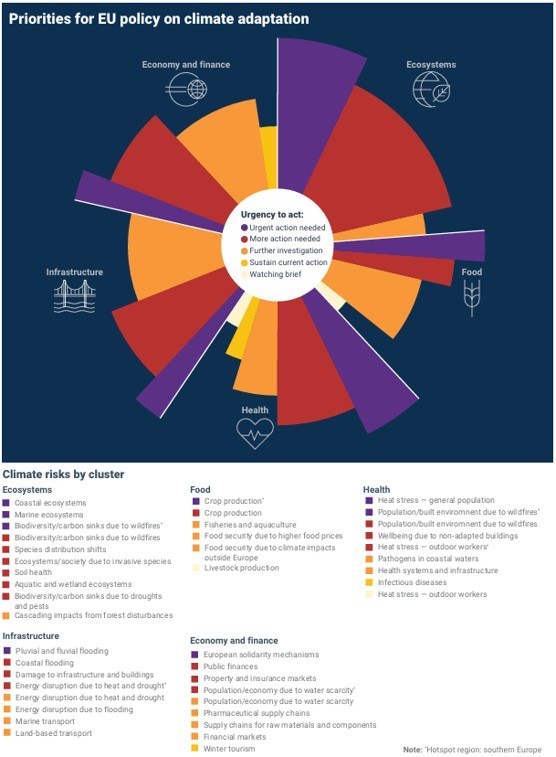
Climate risks in Europe are already widespread, severe and accelerating, requiring coordinated and timely action. The first European Climate Risk Assessment (EUCRA) identifies 36 major climate risks affecting ecosystems, food, health, infrastructure and the economy, many of which require urgent action, as illustrated in the figure below. EU adaptation policy provides a common framework to guide priorities, mobilise resources and integrate climate resilience across sectors and governance levels. It supports coordinated action to reduce vulnerability, limit long-term exposure and prevent escalating climate impacts, while strengthening Europe’s capacity to anticipate, prepare for and respond to climate risks.
Explore further









Language preference detected
Do you want to see the page translated into ?
Exclusion of liability
This translation is generated by eTranslation, a machine translation tool provided by the European Commission.
Exclusion of liability
This translation is generated by eTranslation, a machine translation tool provided by the European Commission.