All official European Union website addresses are in the europa.eu domain.
See all EU institutions and bodies
An official website of the European Union | How do you know?
Environmental information systems
EN


Climate change impacts outside Europe can create risks within Europe through interconnected trade, supply chains, infrastructure, financial systems, geopolitics and human mobility. Understanding these cross-border and cascading risks complements the assessments of climate risks originating within Europe and supports adaptation planning towards a more resilient Europe.
Key messages
Climate risk crosses borders. Climate-related hazards and impacts occurring elsewhere in the world can affect European societies and economies through global systems and interdependencies. The 0 first European Climate Risk Assessment (EUCRA) explicitly notes that climate-related hazards can “cascade from the outside world to Europe” and that such cascades can affect entire societies. Droughts, floods, extreme heat or tropical storms outside Europe can disrupt production, transport and supply chains, affect commodity availability and prices, and contribute to wider economic, geopolitical and societal pressures.
Research on cross-border climate impacts identifies six main pathways as the dominant routes by which external climate impacts reach Europe:
- agricultural commodity trade,
- non-agricultural commodity trade,
- infrastructure & transport,
- geopolitics & security,
- migration,
- finance.
Europe’s exposure varies between sectors and countries depending on factors such as trade relationships, reliance on imported gods and raw materials, supply-chain structures and financial connections. sectors and countries depending on factors such as trade relationships, reliance on imported gods and raw materials, supply-chain structures and financial connections.
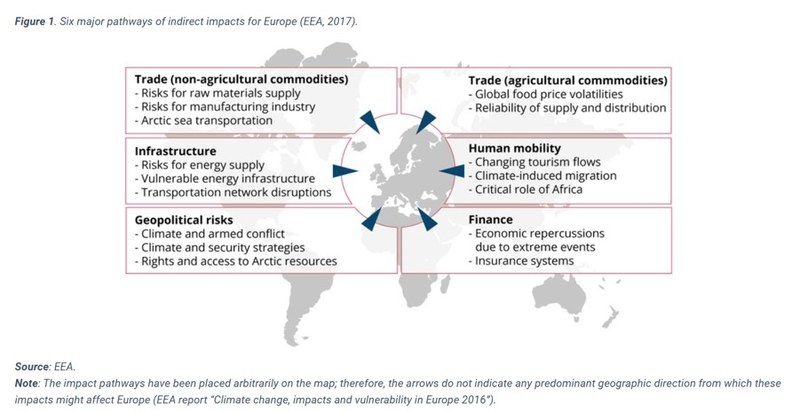
Impacts can cascade across countries and policy sectors. A climate-related event, affecting agriculture production outside Europe, can disrupt international supply, increase food prices and subsequently affect European households, businesses and public finances. Similarly, disruption to transport infrastructure or production centres can propagate through global supply chains. Multiple shocks occurring simultaneously can further amplify these effects. Concrete examples of external climate risk drivers which illustrate the magnitude of impacts are:
- The Russian heat wave in 2010 destroyed about 30 % of Russia’s grain harvest and contributed to an increase of 60–80 % in global wheat prices.
- The small, open and highly developed European economies are expected to be vulnerable primarily to shocks in the flow of non-agricultural commodities. Examples of such indirect effects are the shortage of hard drives and the associated increase in price levels caused by a severe flood event in Thailand in 2011 and the declines in coal exports and the increase in world market prices caused by extreme floods in eastern Australia in 2010/11.
- In 2005, Hurricane Katrina destroyed large parts of the port of New Orleans in the United States, causing a temporary shortage in global oil supply and a temporary increase in the global oil price.
Managing these risks requires looking beyond Europe’s direct exposure to climate hazards. 2024 EUCRA highlights the potential for climate impacts to cascade from outside Europe and interact with existing European vulnerabilities. Understanding these interdependencies can help identify critical supply chains, dependencies and potential transmission pathways and support adaptation across systems including trade, food, finance, security and international cooperation.
Why external climate-risk drivers matter for climate adaptation
Considering climate impacts outside Europe helps decision-makers anticipate risks that cannot be understood from European climate change projections alone. Identifying critical international dependencies and transmission pathways can support more resilient supply chains, trade and finance systems, strengthen preparedness and early-warning, and support cooperation with countries beyond Europe. Integrating cross-border risks that may originate elsewhere but have consequences across European societies and economies into adaptation planning therefore strengthens Europe’s resilience to climate impacts.
Explore further







External links
Language preference detected
Do you want to see the page translated into ?
Exclusion of liability
This translation is generated by eTranslation, a machine translation tool provided by the European Commission.
Exclusion of liability
This translation is generated by eTranslation, a machine translation tool provided by the European Commission.