All official European Union website addresses are in the europa.eu domain.
See all EU institutions and bodies
An official website of the European Union | How do you know?
Environmental information systems
EN


Climate risks are interconnected and often affect several sectors, places, and societal groups at the same time. Cross-sectoral approaches help identify these connections, manage trade-offs, and avoid shifting risks from one sector to another. Integrating adaptation across policies and decisions can support more effective and lasting climate resilience. This section provides an insight into the current knowledge on cross-sector approaches in all steps of the adaptation policy cycle.
Key messages
- Climate risks do not occur in isolation. Impacts on ecosystems, water, health, food, infrastructure and the economy can interact and cascade across sectors and borders. The first European Climate Risk Assessment (EUCRA) identified 36 major climate risks across five interconnected risk clusters (ecosystems, health, food, infrastructure, economy and finance) and highlights the need for coordinated action across policy areas and governance levels.
- Systemic adaptation is a key objective of the 2021 EU Adaptation Strategy, which promotes integrating climate resilience across relevant policy areas, supporting action at local level and promoting nature-based solutions. This means considering climate risks and resilience in sectoral policies and investment decisions rather than addressing adaptation separately. Scientific evidence shows that a lack of mainstreaming of adaptation can even lead to maladaptation: the IPCC shows that maladaptation is identified as a potential outcome when, among others, adaption actions transfer risks rather than reduce them, such as increasing exposure to new hazards or worsening inequality (Working Group II’s Climate Change 2022: Impacts, Adaptation and Vulnerability). Recent EEA assessments reinforce the need for integrated approaches. EUCRA showed how climate risks can cascade across systems. The Climate resilience in Europe – progress and challenges report highlights remaining challenges in areas such as coordination, risk ownership, implementation and cross-border cooperation. Europe’s environment 2025 also emphasised the need for integrated responses to interconnected climate, environmental and societal challenges.
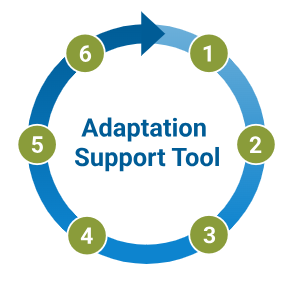
- Climate-ADAPT supports cross-sectoral adaptation through its Adaptation Support Tool (steps 1 and 4), adaptation options and case studies. Although knowledge is organised across 19 policy sectors, these resources help users consider interactions between sectors throughout the adaptation policy cycle. As shown in the 2024 EEA Case study briefing, implemented adaptation measures, reported in the case studies, often address several climate risks simultaneously and can provide lessons on co-benefits, trade-offs and avoiding adaptation failures.
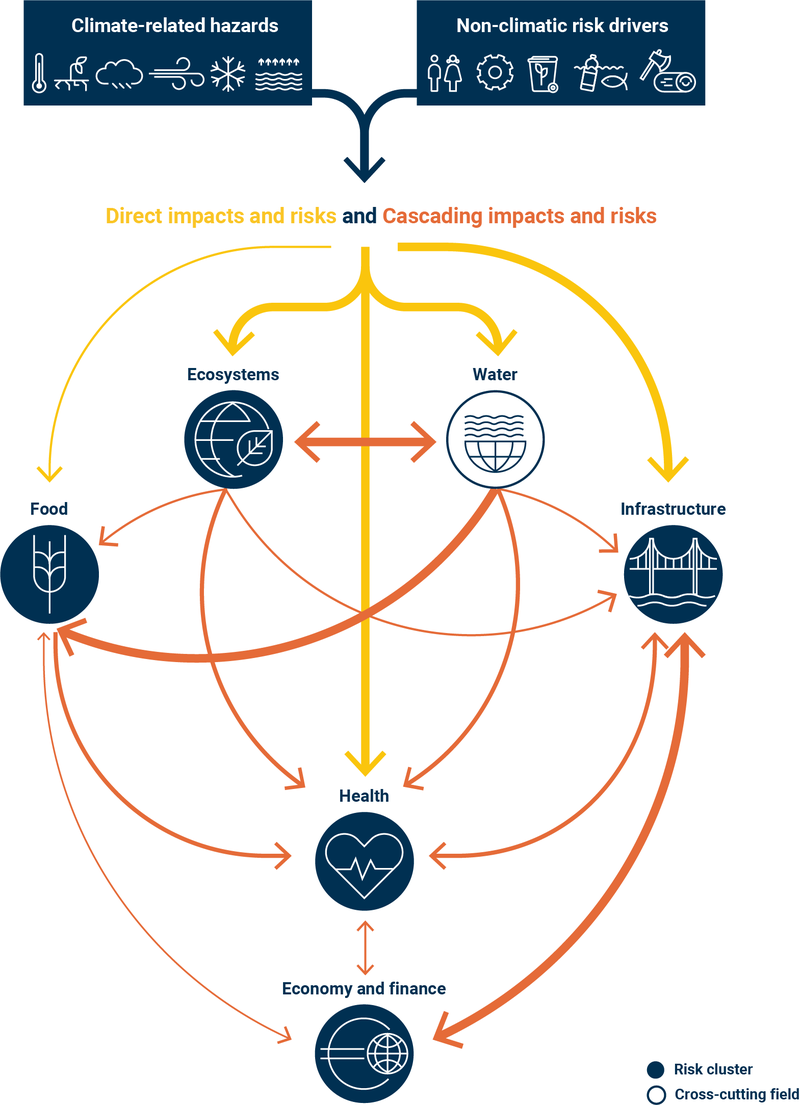
Why cross-sectoral approaches matter for climate change adaptation
Adaptation decisions in one sector can affect climate risks and resilience in others. Without coordination, measures may create conflicting demands, transfer risks or miss opportunities for wider benefits. Cross-sectoral approaches help decision-makers understand these interactions and identify measures that support several objectives at the same time. Integrating adaptation across policy sectors such as water, agriculture, health, biodiversity, infrastructure and spatial planning (and areas via multi-governance coordination) can therefore strengthen resilience, make better use of resources and reduce the risk of maladaptation.
Explore further






External links
Language preference detected
Do you want to see the page translated into ?
Exclusion of liability
This translation is generated by eTranslation, a machine translation tool provided by the European Commission.
Exclusion of liability
This translation is generated by eTranslation, a machine translation tool provided by the European Commission.