All official European Union website addresses are in the europa.eu domain.
See all EU institutions and bodies
An official website of the European Union | How do you know?
Environmental information systems
EN



Athens uses storytelling as a powerful tool to engage citizens and policymakers in addressing the growing threat of extreme heat. Climate stories help make risks more visible and build support for urban heat resilience efforts.
Key Learnings
About the Region
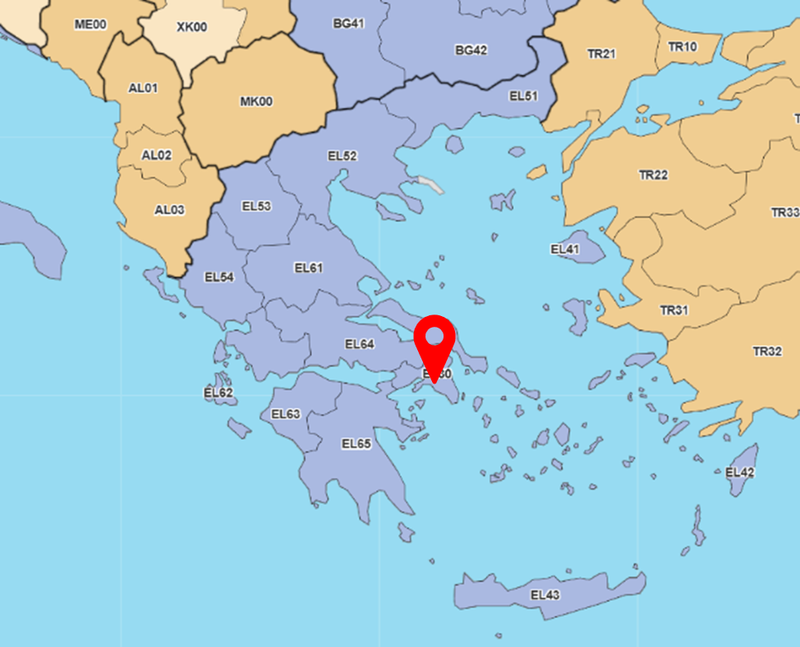
Figure 1: Map of NUTS 2 administrative units of Greece, Eurostat Census 2021. Image Credit: REACHOUT.
Climate Threats
Prolonged and more intense heat waves are one of Athens’ main climate threats. Projections show a substantial increase in the frequency and duration of heat events over the next decades. By 2060, heatwaves will increase by four to eight times, depending on CO2 emissions scenarios. The densely built-up city with limited airflow and green space aggravates heat exposure, especially in vulnerable neighbourhoods with a large share of low-income households, hampering individual adaptation capacity. Those households often lack air conditioning or cannot afford the high energy costs associated with running it. During a heatwave, this leads to elevated indoor temperatures, leaving people highly exposed to heat both day and night. The resulting health risks include cardiovascular problems and a reduced ability to cope with extreme heat. These threats are prompting the city to invest in communication, data tools, and infrastructure to better protect residents.
A climate story as an effective way to tackle heat in Athens

Figure 2: Elissavet Bargianni, Chief Heat Officer of Athens, shares her city's climate story. Image Credit: Sophie van der Horst.
Athens’ climate story takes readers into the past and future climates to better understand the necessary adaptation actions required today. An elderly citizen, reflecting on her life in 2030, considers the changing impacts of heat from her 20s to her current age of 70. Heat waves have been steadily increasing in intensity and frequency over the past 50 years. However, when she spends the day with her grandchildren, she finds relief from the heat in the green spaces, beneath the trees, and through other measures that the city implemented in previous years (e.g. municipal clinics, climate shelters), enabling citizens to manage heat waves much more effectively by 2030.
A creative co-creation process, involving individuals from the municipality, consultants, climate service experts, and research partners from the REACHOUT project consortium, enabled the development of this climate story. It highlights how Athens is tackling heat and protecting its citizens by bringing everyone together around a common approach. The city contributed relevant photos, such as retrofitted urban spaces, as well as key locations, relatable characters, historical climate events, and compelling storylines. At the same time, the research partners provided data and graphics on past and future heat waves. Using a step-by-step process, the knowledge brokers and climate service experts guided the development of a story incorporating scientific evidence and local relevance, proposing narratives with easy-to-understand text and visuals (Figure 3). The technical expert developed workshops that the city council delivered, engaging diverse departments (Resilience, Planning, Greening, Social Services, Education), which were essential for gathering cross-sectoral insights and building support for the innovative climate story approach. Ultimately, the climate story proved to be not only an effective tool for raising community awareness but also a governance instrument that fosters cross-departmental collaboration.

Figure 3: Snapshots from the climate story illustrating the use of photos, visuals, and characters to bring climate change knowledge to life. Image Credit: REACHOUT.
Athens’ climate story unites local places, characters, and events with scientific knowledge and data on climate change. This outcome was achieved through close collaboration with city representatives, a locally embedded knowledge broker, climate service experts, and climate change researchers.
Eva Boon, Climate Researcher / Advisor
Summary
Further Information
Contact
Keywords
Climate Impacts
Adaptation Sectors
Key Community Systems
Countries
Funding Programme
Disclaimer
The contents and links to third-party items on this Mission webpage are developed by the MIP4Adapt team led by Ricardo, under contract CINEA/2022/OP/0013/SI2.884597 funded by the European Union and do not necessarily reflect those of the European Union, CINEA, or those of the European Environment Agency (EEA) as host of the Climate-ADAPT Platform. Neither the European Union nor CINEA nor the EEA accepts responsibility or liability arising out of or in connection with the information on these pages.
Language preference detected
Do you want to see the page translated into ?
Exclusion of liability
This translation is generated by eTranslation, a machine translation tool provided by the European Commission.
Exclusion of liability
This translation is generated by eTranslation, a machine translation tool provided by the European Commission.