All official European Union website addresses are in the europa.eu domain.
See all EU institutions and bodies
An official website of the European Union | How do you know?
Environmental information systems
EN



Budapest Declaration: accelerating action for healthier people, a thriving planet, a sustainable future
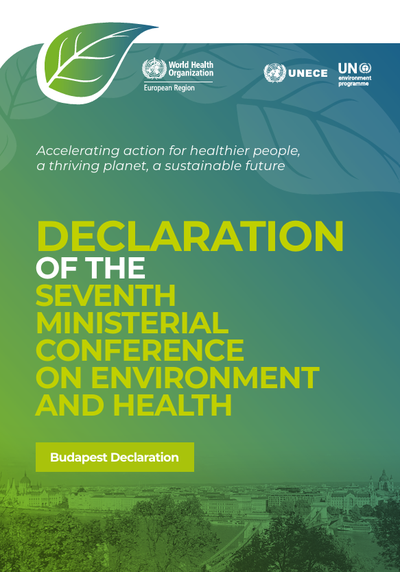
Adopted on 6 July 2023 by health and environment ministers of WHO European Region countries, the Budapest Declaration formulates political commitments and actions to address the health risks posed by the triple crisis of climate change, pollution and biodiversity loss along with – and in the context of – recovery from COVID-19. The Declaration prioritizes urgent, wide-ranging action on health challenges related to this triple crisis, and aims to accelerate the just transition towards resilient, healthy, equitable and sustainable societies. By adopting the Budapest Declaration, countries have committed to tackling pollution and climate change, ensuring everyone has access to safe water, sanitation and hygiene services, integrating nature and biodiversity considerations into policies, and promoting a clean, safe and healthy built environment. Additional commitments targeted health systems.
The Declaration promotes health sector engagement in climate change and makes the case for health in climate policy-making. With regard to adaptation policy, a key commitment is the development, update and implementation of health national adaptation plans, either as standalone documents or as a part of wider national adaptation planning efforts. The second edition of the paper Zero regrets: scaling up action on climate change mitigation and adaptation for health in the WHO European Region, launched at the 7th Ministerial Conference on Environment and Health in Budapest, provides a backdrop to and supports the adoption and implementation of the commitments on climate change and health embodied in the Declaration through a portfolio of high-level asks and concrete implementation actions.
To support countries’ implementation capacities, the Declaration also aims to strengthen governance, investment in human resources and the generation of knowledge and tools for action. It also emphasizes the empowerment of youth organizations to make their actions more relevant in policy-making and implementation. The Roadmap for healthier people, a thriving planet and a sustainable future 2023–2030 is an integral part of the Declaration and describes a set of actions to expedite the necessary transitions. To accelerate the implementation of the commitments, the European Environment and Health Process (EHP) Partnerships were launched as a new action-oriented mechanism. It aims to bring together countries and partners with a shared interest in a specific thematic area to work together on joint projects and activities. Four EHP Partnerships were launched, focusing on health sector climate action, youth collaboration, human biomonitoring, and healthy mobility. The Partnership for Health Sector Climate Action aims to provide a regional community of practice to share approaches, experience and research as countries chart pathways and solutions to developing climate-resilient, low-carbon and environmentally sustainable health systems.
In the European policy context, the Declaration will support among others the European Green Deal, the EU Global Health Strategy, the EU Research and Innovation Framework Programmes (Horizon Europe and predecessors), and the EU Regulation on serious cross-border health threats.
To support countries’ implementation capacities, the Declaration also aims to strengthen governance, investment in human resources and the generation of knowledge and tools for action. It also emphasizes the empowerment of youth organizations to make their actions more relevant in policy-making and implementation. The Roadmap for healthier people, a thriving planet and a sustainable future 2023–2030 is an integral part of the Declaration and describes a set of actions to expedite the necessary transitions. To accelerate the implementation of the commitments, the European Environment and Health Process (EHP) Partnerships were launched as a new action-oriented mechanism. It aims to bring together countries and partners with a shared interest in a specific thematic area to work together on joint projects and activities. Four EHP Partnerships were launched, focusing on health sector climate action, youth collaboration, human biomonitoring, and healthy mobility. The Partnership for Health Sector Climate Action aims to provide a regional community of practice to share approaches, experience and research as countries chart pathways and solutions to developing climate-resilient, low-carbon and environmentally sustainable health systems.
In the European policy context, the Declaration will support among others the European Green Deal, the EU Global Health Strategy, the EU Research and Innovation Framework Programmes (Horizon Europe and predecessors), and the EU Regulation on serious cross-border health threats.
Working Group on Health in Climate Change: WHO EUROPE
The WHO Working Group on Health in Climate Change (HIC) was established in 2012 under the mandate of the European Environment and Health Task Force (EHTF) at the request of the Member States of the WHO European Region to protect health from the adverse effects of climate change. EHTF is the leading international body for implementation and monitoring of the European Environment and Health Process, in particular of the commitments laid down in the Ostrava Declaration on Environment and Health.
The HIC Working Group consists of nominated representatives of Member States and partners. It facilitates dialogue and cooperation among the Member States in the WHO European Region and other stakeholders, as well as communication and implementation of commitments to protect health from the adverse effects of climate change. Specifically, the Working Group promotes and advocates integration of health considerations in national climate change mitigation and adaptation policies and acts as a catalyst in promoting, implementing, and monitoring climate change and health commitments in the Ostrava Declaration at international, national and subnational levels. HIC provides a platform for exchange of experiences and innovations, promotion of tools, communication of evidence and demonstrating good practices in climate change and health and encourages partnership among countries and stakeholders.
WHO Europe work on climate change and health
In 2018, WHO/Europe published a report, Public health and climate change adaptation policies in the European Union, which analyses developments in health policies for climate change adaptation in EU countries and compiles a selection of good practice case studies.
As the WHO European Region is the fastest warming region in the world, WHO/Europe has published key documents to support Member States with up-to-date information and guidance on heat and health, including the review: Heat and health in the WHO European Region: updated evidence for effective prevention. With financial support from the European Commission, WHO/Europe is developing an updated, second edition of the guidance on heat–health action plans (HHAPs). This edition aims to support decision-makers and practitioners in the health sector and beyond in developing coordinated, comprehensive HHAPs. Although primarily aimed at Member States in the WHO European Region, the guidance is expected to be of international relevance.
Floods are the most frequent natural disaster in the WHO European Region, with one-tenth of the urban population living in flood-prone areas. To address the health impacts of floods, WHO/Europe has developed guidance, including the publications Flooding: managing health risks in the WHO European Region and Floods and health: fact sheets for health professionals. A dedicated web page provides a one-stop-shop for WHO resources on floods. Under the UNECE-WHO/Europe Protocol on Water and Health, work is underway to strengthen the climate resilience of water and sanitation services, including to floods.
The Health and Climate Change Country Profiles initiative is the foundation of WHO’s work to monitor national and global progress on health and climate change. Developed in collaboration with the national health authorities, these profiles provide data-driven snapshots of climate hazards and the expected health impacts of climate change, track current policy responses, and summarize the key priorities for national climate and health action. Globally, more than 80 countries have participated in this initiative since its launch in 2015, including several Member States from the WHO European Region.
Further information
Language preference detected
Do you want to see the page translated into ?
Exclusion of liability
This translation is generated by eTranslation, a machine translation tool provided by the European Commission.
Exclusion of liability
This translation is generated by eTranslation, a machine translation tool provided by the European Commission.