All official European Union website addresses are in the europa.eu domain.
See all EU institutions and bodies
An official website of the European Union | How do you know?
Environmental information systems
EN



The health sector plays a critical role in society’s well-being, but it is also a significant contributor to greenhouse gas (GHG) emissions. While the study of the health risks of climate change are now a well-established field of research (Kirk et al. 2021, Pichler et al., 2019), our understanding of the contribution of the healthcare sector to climate change through its emissions of greenhouse gases is still developing.
Reducing health sector greenhouse gas emissions (GHG) is a key part of the society-wide effort to reach net zero emissions. Understanding where emissions occur in healthcare systems is therefore key to identifying opportunities for climate action.
What are the sources of GHG emissions in the health system?
Following the standards of GHG accounting, emissions from the health sector can be classified into three main categories:
- Direct emissions (Scope 1) come from on-site energy use, such as heating, cooling, and generators, facility operated transport systems, and from the use of high-impact medical gases like anaesthetics.
- Indirect emissions from purchased energy (Scope 2) are linked to electricity, heating, and cooling bought from external providers.
- Other indirect emissions (Scope 3) include emissions from the production and transport of pharmaceuticals, medical equipment, and food services, as well as staff and patient transport (i.e. own vehicle to and from work or to an appointment), cleaning services and waste management.
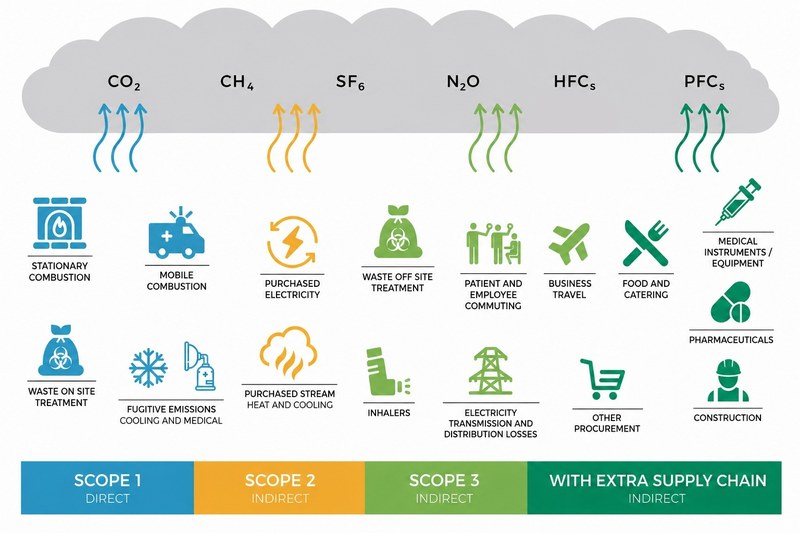
Source: Adapted from Health Care Without Harm, 2022
In the European Union, the health system accounted for 4.29% of national GHG emissions on average in 2014 (Health Care Without Harm, 2021). Yet, significant variations exist between countries in the proportion of national emissions caused by healthcare (from 2% to 6% in some countries), and in the sources of health system emissions themselves, classified into scopes.
Notes:
Data refer to 2018.
*The EEA-32 averages exclude Cyprus, Liechtenstein and Malta, as data for these countries were not available.
** Average Health System Emission by Scope 1–3: Estimates do not sum exactly to 100% due to differences in data sources, system boundaries and estimation methods. Figures should therefore be interpreted as indicative.
Scope 1 refers to direct emissions occurring within health facilities. Scope 2 refers to indirect emissions from purchased electricity used in health facilities. Scope 3 refers to all other indirect emissions across the healthcare supply chain.
Source: Adapted from OECD (2025).
The majority of health system emissions arise from indirect sources. In 2018, around 78% of healthcare emissions in EU countries originated from supply chains (Scope 3), highlighting the importance of procurement and production systems in efforts to reduce emissions (2018 EU average excl. Cyprus and Malta, own calculations based on OECD, 2025).
Healthcare emissions in numbers
4.29%
Share of all national demand-based emissions1
78%
of health system emissions originate from supply chains (scope 3)1
77%
Increase in GHG emissions from the global pharmaceutical industry2
1 2018 EEA-32 average (excl. Cyprus, Liechtenstein, and Malta, own calculations based on OECD, 2025)
2 1995-2019 (Haagenars et al, 2025)
How can health systems reduce emissions?
The most efficient levers for health system decarbonisation vary by country. This is because the contribution of each emission scope to the total emissions of the health system varies by country.
Reducing Scope 1 emissions involves either improving the efficiency of energy use from fossil sources, or transitioning to renewable sources of primary energy for heating and cooling. In the context of hospitals, reducing leakage of some medical gases can have an impact on GHG emissions, as some gases used as anaesthetics such as desfluorane have a GHG effect hundreds of times more potent than carbon dioxide (Health Care Without Harm, 2019). Emissions from energy use for the transport of patients by the health system also falls into Scope 1 emissions, which can be reduced through the use of electric vehicles instead of vehicles using internal combustion engines, and the transition to more sustainable aviation fuels for air transport of patients.
In the context of Scope 2 emission reductions, transitioning from a fossil fuel to a renewable power supply is an important lever for emissions reductions. In the case of emission-intensive district cooling or heating systems supplying hospitals, a retrofitting of the cooling or heating network to accommodate more sustainable energy sources might be necessary to reduce emissions. In addition, reducing electricity use by investing in the energy efficiency of buildings is also a lever to reduce emissions from purchased electricity.
Scope 3 emission reductions encompass limiting indirect emissions from the production and transport of products or people to the site via personal transport or contractors. The production of pharmaceutical products and medical devices is a major source of greenhouse gas emissions because of energy-intensive manufacturing processes. For these emissions, action must happen at the level of manufacturers, but also at the level of procurement strategies for healthcare professionals that prioritise sustainably made products. The sustainable supply of food to hospitals can also be a lever for Scope 3 emission reductions, through the use of locally sourced products with a lower carbon footprint and organisational changes to prevent food wastage (Talbot et al., 2025). Finally, a more sustainable management of waste, water and sanitation can also contribute to a reduction in Scope 3 emissions (Oruçoğlu et al., 2024).
By reducing emissions across direct and indirect sources, the footprint of health system activities can be reduced in a comprehensive manner, as the example of the Geneva healthcare system shows:

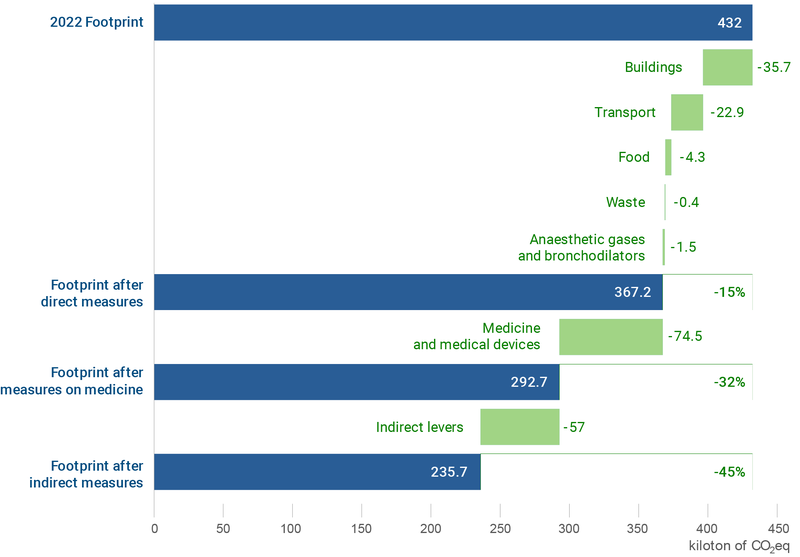
Source: Adapted from Mermillod et al., 2024
Beyond the broad ranging measures highlighted here, the literature also emphasises the importance of changing daily practices within health systems to reduce emissions. Ultimately, a more environmentally sustainable health system can be achieved if healthcare practitioners and administers take best practices on board and apply them in their daily work (Yeboah et al., 2024).
Examples of initiatives
The following examples from across Europe illustrate how different types of initiatives can address emissions across the various scopes of the health system.






References
Language preference detected
Do you want to see the page translated into ?
Exclusion of liability
This translation is generated by eTranslation, a machine translation tool provided by the European Commission.
Exclusion of liability
This translation is generated by eTranslation, a machine translation tool provided by the European Commission.