All official European Union website addresses are in the europa.eu domain.
See all EU institutions and bodies
An official website of the European Union | How do you know?
Environmental information systems
EN



Summary of the session on climate change and health inequities at the European Health Forum Gastein, October 2025.
Watch the full session here (link to YouTube).
“Houston, we have a problem”
Bad Hofgastein, October 2025 — The climate crisis and inequality are closely linked, each exacerbating the other in ways that threaten the physical and mental health of communities worldwide and across generations. Existing socioeconomic and demographic disparities, render certain individuals and groups more susceptible to the negative impacts of climate change. In turn, exposure to heat, extreme weather, air pollution and other climate-related risks further widens these gaps. Climate change, in effect, acts as a risk amplifier, exacerbating vulnerabilities and worsening health inequalities and their profound impact on both individuals and society.
The climate crisis and inequality are closely linked, each exacerbating the other in ways that threaten the physical and mental health of communities worldwide and across generations. Existing socioeconomic and demographic disparities, render certain individuals and groups more susceptible to the negative impacts of climate change. In turn, exposure to heat, extreme weather, air pollution and other climate-related risks further widens these gaps. Climate change, in effect, acts as a risk amplifier, exacerbating vulnerabilities and worsening health inequalities and their profound impact on both individuals and society.
At the 2025 European Health Forum Gastein, the European Commission’s Directorate-General for Research and Innovation and the European Climate and Health Observatory co-hosted a session on Climate Change and Health Inequalities. Moderated by Aleksandra Kazmierczak (European Environment Agency), the discussion featured insights from Maurizio Curtarelli (EU-OSHA), Jan C. Semenza (Lancet Countdown in Europe, Heidelberg University, Umeå University and Horizon Europe Climate-Health Cluster), Rita Araújo (European Commission), Francesca Racioppi (WHO European Centre for Environment and Health) and Vania Putatti (EuroHealthNet and Horizon Europe Climate-Health Cluster).
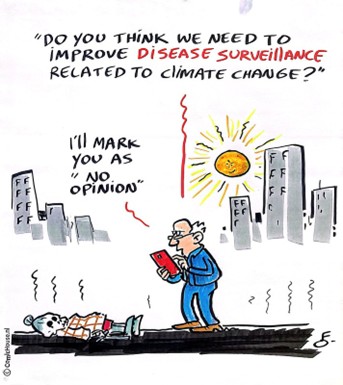
Cartoon developed by during the session, highlighting the message that action must be accelerated beyond evidence generation and data collection in order to effectively tackle climate and health inequalities at a rate that meets the urgency of the impacts.
Inequalities in the spotlight: who bears the brunt?
The session’s first segment focused on recent advances in knowledge and advocacy activities aimed at addressing climate-driven health inequalities. Key takeaways included:
- Inequalities define many aspects of the health of workers in the context of climate change: Curtarelli presented findings from the OSH Pulse 2025 survey, which polled workers across the EU, Iceland, Norway and Switzerland. The data exposed disproportionate climate impacts on outdoor, manual or low-skilled workers as well as those with migrant status. Wide disparities also exist between regions and job sectors, and one-third of respondents reported exposure to climate risks such as extreme heat, poor air quality and extreme weather events, with a clear link between these exposures and the emergence of health issues. Curtarelli emphasised the importance of workplaces recognising the risks associated with climate change and implementing effective measures to prevent and manage those risks, particularly for the most affected workers.
- We know who is at risk and how, yet inaction allows inequality to persist: Semenza highlighted the deadly toll of recent heatwaves in Europe and beyond, pointing to gaps in understanding the impact of heat on population health and in the capacity of governments to mitigate risks and lower mortality. He highlighted how well-coordinated heat health action plans that effectively link early warning systems to public health action can save lives. He also called for stronger surveillance systems to better detect and respond to heatwaves as well as climate-sensitive diseases such as dengue, chikungunya and Zika. Semenza warned that underinvesting in early warning systems and health systems leaves vulnerable groups, such as low-income populations, exposed to greater risk.
- Inequalities must be considered in future research and innovation funding priorities: Araújo highlighted the Strategic Research and Innovation Agenda (SRIA) on Health and Climate Change, which sets out a strategic vision for climate and health research in the years ahead. She revealed that during consultations, health inequalities came to the forefront of discussions as critical. The SRIA includes a chapter on climate-driven health inequalities and takes into account socioeconomic and health vulnerabilities throughout. Araújo also announced two flagship initiatives under the Strategy for European Life Sciences: one to implement the SRIA through the Horizon Europe programme and another to improve global coordination of climate-health funding and solutions through a funder’s platform, both offering ample opportunity to address inequalities through research and its implementation.
- Governance gaps and lack of political momentum help inequalities persist: Racioppi introduced the Pan-European Commission on Climate and Health, a WHO-led effort to engage independent leaders from different disciplines and parts of the WHO European Region to develop a “Call to Action” with the aim of mobilising Member States and identifying effective and evidence-based political entry points and levers for action. The Commission helps overcome political inertia in scaling up and accelerating the implementation of climate-health solutions, including those designed to address health inequalities. Racioppi noted the striking example of heat health action plans, which are essential tools for prevention and equity, and yet only 22 of 53 countries in the WHO European Region have reported to have one in place.
- To address climate-driven health inequalities we need more holistic policy frameworks: Putatti emphasised the importance of developing a comprehensive EU Strategy on Climate and Health, noting that addressing climate change as key public health determinant remains essential. The complex interlinkages between different determinants of health shows the need for an integrated, multi-sectorial political strategy that spans across different policy areas, including the upcoming EU initiatives such as the Anti-Poverty Strategy, the Action Plan for the European Pillar of Social Rights, and plans on affordable housing and energy. Putatti stressed the need for stronger investment within the next Multiannual Financial Framework (MFF) to drive effective and meaningful action on climate and health inequalities.
The view from the audience: local action, child-centric policies and civil society voices
Session participants raised several critical points during the discussion, including the need to support frontline community health workers to ensure strong equity-based, bottom-up responses at the local level. Adequately supporting and funding civil society actors was also mentioned as a priority. Others highlighted the disproportionate vulnerability of children to air pollution and extreme heat, urging for more targeted policies. Questions about financing mechanisms also revealed a dilemma: while funding opportunities exist, the health sector clearly lacks the capacity to access them, constituting a barrier which public authorities must help to overcome.
From evidence to action: breaking silos, upstream efforts and accelerating change
A Slido poll conducted during the session asked attendees to identify the most urgent steps to address climate-driven health inequalities. The results reflected a broad consensus on prioritising systemic change to address the root causes of inequalities in the social realm, the physical environment and in research and policy activities alike.
Slido poll results

The panellists responded to the poll results with commitments, expressions of support and details on the next steps in their respective roles:
- Curtarelli reaffirmed the need to support climate adaptation efforts and prevention measures in workplaces by developing practical tools and risk assessment mechanisms and encouraged the direct participation of workers in designing adaptation measures.
- Putatti presented the work of the Horizon Europe Climate-Health cluster, which, among others, aims at improving surveillance systems by integrating sociodemographic indicators and collecting disaggregated data to timely inform public interventions. He noted that the cluster will soon publish a policy brief outlining each project’s efforts in addressing climate and health inequalities.
- Semenza stressed that while evidence is crucial, the urgently needed transition to a climate-resilient society will require much more, citing the dismantling of counterproductive policies (e.g., fossil fuel subsidies) as an example.
- Araújo called for faster translation of research into action that also leaves space for the needs of vulnerable people, acknowledging that although climate change demands urgency, solutions cannot be one-size-fits-all.
- Racioppi welcomed the audience’s focus on the upstream determinants of health, which aligns with WHO’s upcoming European Programme of Work (2026-2030), where climate change and inequalities feature prominently.
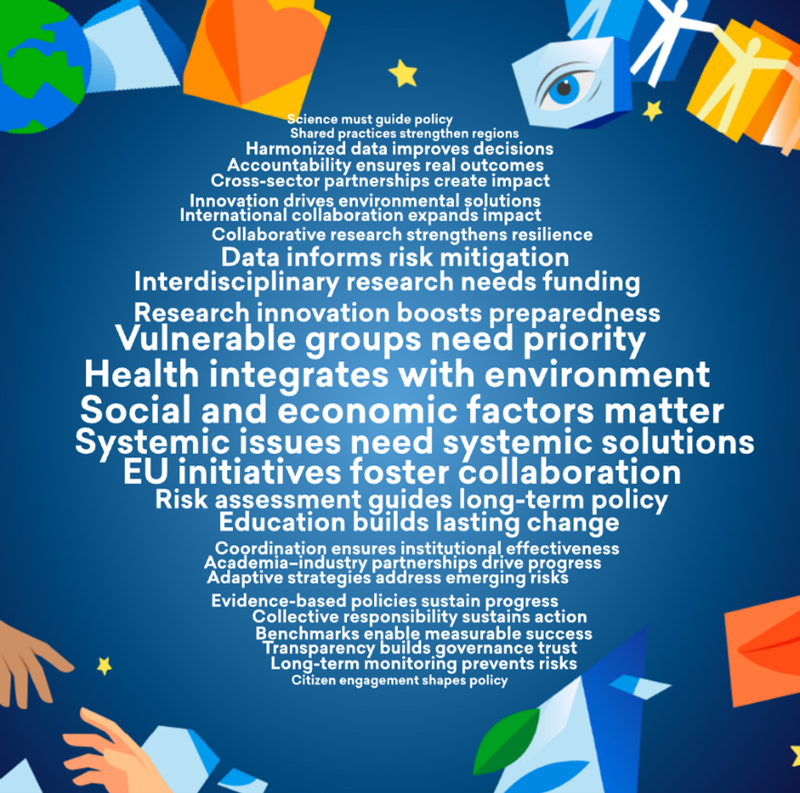
Word cloud developed with the main messages from the speakers.
Conclusions
“A lot is happening, but not at the scale and pace that is needed. […] Houston, we have a problem.”
– Francesca Racioppi (Head of Office, WHO European Centre for Environment and Health)
Overall, the session concluded with a stark consensus: while research and awareness have advanced, systemic change requires urgent, coordinated action. Panellists agreed that addressing climate-driven health inequalities demands an acceleration of evidence translation, holistic policies, cross-silo, interdisciplinary collaboration in research and governance, sustained funding and prioritisation of vulnerable groups in adaptation efforts. The organisations represented in the panel committed to advancing these actions and urged all stakeholders to match the urgency of the crisis with actionable and inclusive evidence, robust solutions and decisive interventions.
The message was clear: without immediate, inclusive action, climate-driven health inequalities will deepen and carry devastating human costs.
Language preference detected
Do you want to see the page translated into ?
Exclusion of liability
This translation is generated by eTranslation, a machine translation tool provided by the European Commission.
Exclusion of liability
This translation is generated by eTranslation, a machine translation tool provided by the European Commission.