All official European Union website addresses are in the europa.eu domain.
See all EU institutions and bodies
An official website of the European Union | How do you know?
Environmental information systems
EN


Climatic risk drivers are physical climate variables – such as rising temperatures, changing precipitation, sea-level rise and extreme events – that directly trigger climate-related hazards and shape exposure, vulnerability and impacts across Europe. Understanding how these drivers evolve, interact and differ is fundamental to assessing climate risks and planning effective adaptation.
Key messages
Europe's changing climate is intensifying the drivers of climate risk.Climatic risk drivers describe physical climate conditions — such as temperature, precipitation, wind, snow and ice, and ocean and coastal conditions — that can affect people, ecosystems and economic activities. The Intergovernmental Panel on Climate Change (IPCC) defines these as climatic impact drivers (CIDs). Their effect can be beneficial, neutral or harmful, depending on the place, system and thresholds concerned.
- Climate-related hazards are a subset of CIDs that are mainly harmful (e.g. heatwave days, heavy precipitation, drought).
- Climate risk drivers are already changing Europe, but not uniformly. Europe is the fastest-warming continent, with temperatures increasing around twice as fast as the global average. Heatwave frequency and intensity are rising, heavy downpours are becoming more severe, and sea level is projected to keep rising (low- and high-scenario pathways). These changes in climate risk drivers give rise to various kinds of adaptation challenges in different places. For example, due to shifts in regional precipitation patterns, Northern Europe is seeing increased annual and heavy‑rainfall totals, whereas Southern and Central Europe face increasing heat, declining summer precipitation and heightened drought risk.
Figure 1: Observed and projected trends in key climatic risk drivers in different
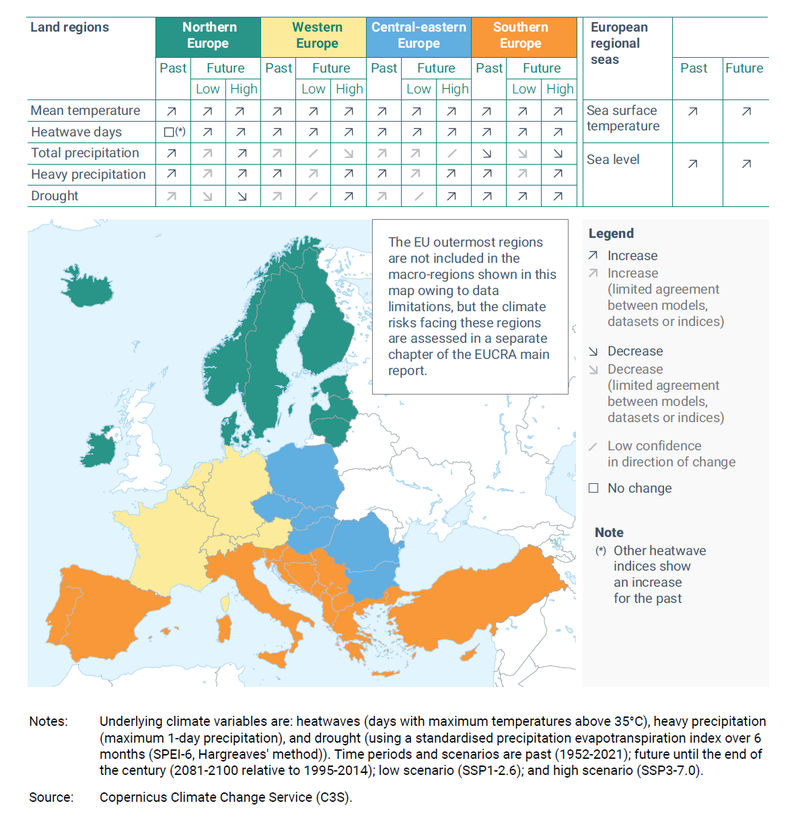
Source: European Climate Risk Assessment
Climate risk drivers can occur together and interact. Compound events amplify impacts and create tail-risk scenarios that are often underrepresented in climate models. Heat and drought, for example, can combine to increase water scarcity, wildfire conditions and pressures on agriculture and ecosystems. Climate-related impacts can also cascade between sectors and regions, meaning that an initial climatic event can ultimately affect food and energy security, infrastructure, health or financial stability.
- The most severe outcomes emerge from the combination of interconnected climatic risk drivers, compounded by non-climatic risk drivers and cascading multi-sectoral impacts (e.g. heat-driven drought → water scarcity → food insecurity → economic stress). EUCRA therefore considers compound and cascading risks alongside individual hazards.
- Climatic risk drivers alone do not determine climate risk.The severity of climate impacts also depends on who and what is exposed and how vulnerable they are. Non-climatic risk drivers such as the way in which land is used, ecosystem degradation, social inequalities, infrastructure and institutional capacity, can amplify or reduce the consequences of changing climatic conditions.
Figure 2: Links between risk drivers and the clusters of climate risks assessed
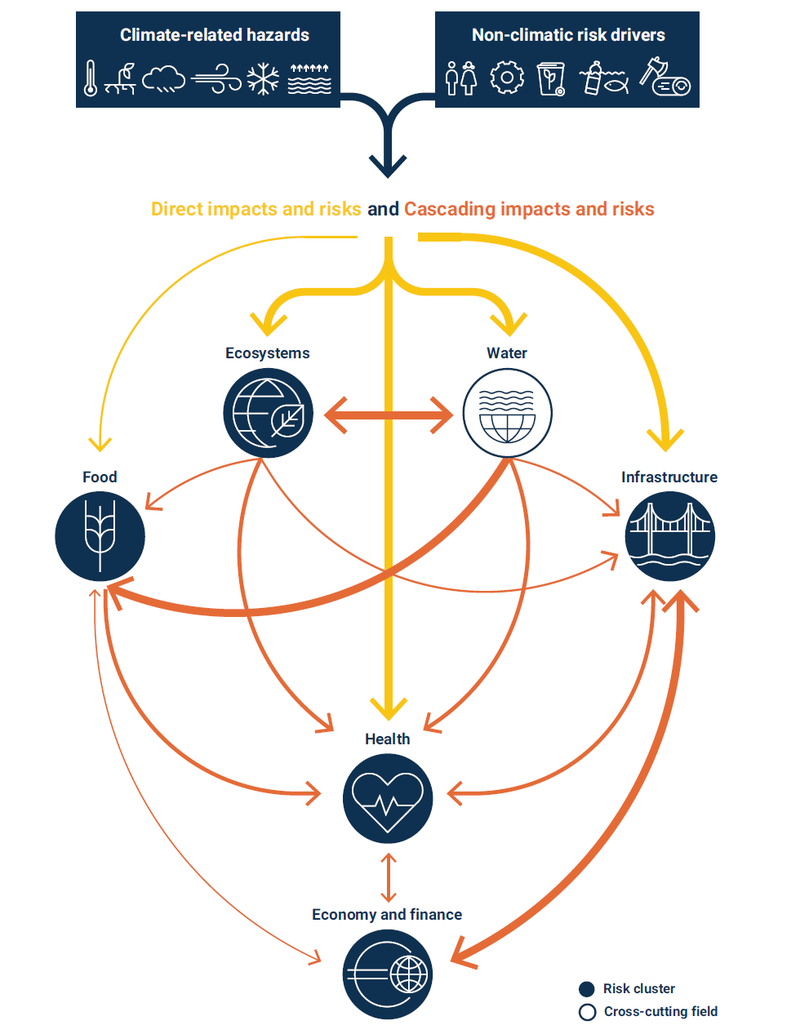
Source: European Climate Risk Assessment
Why climatic risk drivers matter for climate change adaptation
Climatic risk drivers define the physical “shock” that societies must absorb. Their observed acceleration (e.g., more frequent heatwaves, rising seas) directly raises exposure, while their future trajectories define the scope for adaptation needs. Understanding how climatic risk drivers are changing helps decision-makers identify and target the most urgent hazards. Information on observed trends and future projections can support climate risk assessments, identify adaptation priorities and inform decisions on climate-resilient infrastructure, spatial planning, ecosystem management, human health and other climate-sensitive policy sectors. Because climatic drivers differ between regions and can interact, adaptation needs to consider local conditions as well as compound and cascading risks.
Explore further





External links
Language preference detected
Do you want to see the page translated into ?
Exclusion of liability
This translation is generated by eTranslation, a machine translation tool provided by the European Commission.
Exclusion of liability
This translation is generated by eTranslation, a machine translation tool provided by the European Commission.