All official European Union website addresses are in the europa.eu domain.
See all EU institutions and bodies
An official website of the European Union | How do you know?
Environmental information systems
EN



Under the changing climate, wildfires are becoming more frequent, intense, and widespread; hotter and dryer weather creates the perfect conditions for wildfires to spread. In Europe, it is estimated that 95% of wildfires are caused directly or indirectly by human activities, increasingly the likelihood that wildfires will occur in areas close to where people live (EEA, 2026).
This analysis quantifies how many people – and which population groups – live in areas exposed to wildfire. The analysis combines satellite-derived burned area data from the European Forest Fire Information System (EFFIS) from 2019 – 2023 with the Eurostat 2021 Census population grid, allowing exposure to be broken down not only by country but also by age, employment status, and place of birth.
- Across Europe, approximately 270,000 people (0.06% of the EU population) live within areas that were burned at least once between 2019 and 2023.
- Exposure of population to wildfires is heavily concentrated in southern Europe. Italy records the largest absolute number of exposed people (over 127,000), while Portugal and Greece show the highest share of their national population exposed (~0.40% and ~0.39% respectively).
- In Spain and Portugal, people over the age of 65 are over-represented in burnt areas compared to their share of the national population. In Spain, they make up 28.4% of the population in burnt areas, but only 19.7% of the general population. Similarly, in Portugal people over 65 make up 30.4% of the population in burnt areas, but only 23.4% of the national population.
- In Bulgaria, people 14 and under are disproportionately exposed to burnt areas. While they only make up 14.6% of the country population, they represent 31.4% of the people exposed to burnt areas. In all other countries, the share of people 14 and under who are exposed to burnt areas is roughly aligned with their share of the national population.
- In all countries except for Greece, the share of people born outside of the EU who live in a burnt area is roughly in line with their share of the national population. In Greece, people born outside of the EU make up 8.6% of the population, but represent 9.5% of the population exposed to burnt areas.
- In Croatia, Italy, Romania, and Spain, people not in employment make up a higher share of the population in burnt areas than their share of the national population.
Explore the data viewer below:
People living in areas exposed to wildfires (burnt areas) between 2019 - 2023
Note: For the demographic analysis, countries with fewer than 500 exposed individuals were excluded to avoid potential overestimation due to methodological limitations in harmonising Europe-wide datasets.
References
Related resources
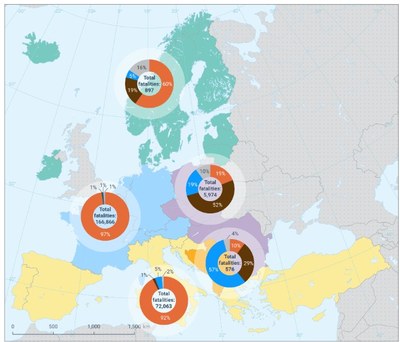
Economic losses and fatalities from weather- and climate-related extremes

Language preference detected
Do you want to see the page translated into ?
Exclusion of liability
This translation is generated by eTranslation, a machine translation tool provided by the European Commission.
Exclusion of liability
This translation is generated by eTranslation, a machine translation tool provided by the European Commission.