All official European Union website addresses are in the europa.eu domain.
See all EU institutions and bodies
An official website of the European Union | How do you know?
Environmental information systems
EN


Measuring progress towards climate resilience is complex and requires approaches tailored to different risks, sectors and governance levels. The EEA's Risk, Response and Result (3R) framework offers a structure for organising indicators. The accompanying database below helps policymakers and practitioners identifying indicators to support Monitoring, Evaluation and Learning (MEL) across Europe.
Key messages
Assessing progress towards climate resilience is inherently complex. Climate risks, vulnerabilities and adaptation solutions vary across geographical areas, sectors and governance levels, while the social, economic and environmental systems involved are closely interconnected. MEL approaches therefore need to reflect local contexts, different starting points and the specific objectives of adaptation policies and actions (EEA, 2026).
Indicators are essential for tracking progress, assessing outcomes and informing decisions (EEA, 2020). However, selecting meaningful indicators can be difficult, particularly when adaptation objectives are not clearly defined or indicators do not adequately capture changes in climate risks, the implementation of adaptation measures and their resulting impacts.
The EEA's 3R framework offers a European-wide structured approach to organising indicators across three complementary dimensions.
Figure 1 - 3R assessment framework
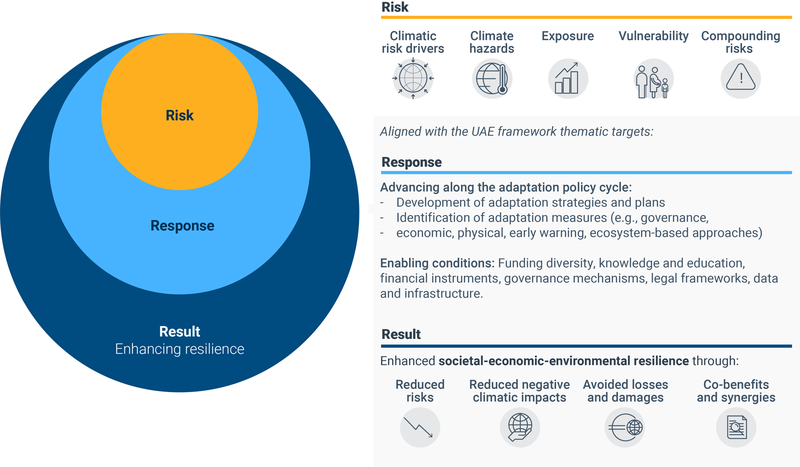
Note: The framework draws on guiding principles from Singh et al. (2022): (1) maximising economic benefits, (2) improving well-being, (3) reducing vulnerability, (4) enhancing resilience, (5) linking to sustainable development, (6) avoiding maladaptation, and (7) ensuring equity and justice. It also reflects the targets of the UAE Framework for Global Climate Resilience, supporting monitoring of both the response and result dimensions.
Risk – indicators covering climate drivers and hazards, exposure, vulnerability, and direct or cascading impacts.
Response – indicators tracking adaptation resources, investments, enabling conditions and the implementation of adaptation actions, including their cost-effectiveness, co-benefits and equity implications.
Result – indicators assessing the outcomes of adaptation actions, from short-term reductions in climate risks to longer-term improvements in societal, economic and ecosystem resilience.
The accompanying adaptation indicator database builds on a 2023 EEA mapping exercise that identified numerous adaptation frameworks and over 1,000 existing indicators. It brings together existing knowledge to support public authorities and practitioners in developing or strengthening their own MEL approaches. Users can explore indicators by governance level, sector, and 3R type, helping them identify relevant options for their specific adaptation context.
Why Monitoring, Evaluation and Learning (MEL) matters for climate change adaptation
Climate change adaptation is an ongoing process in which risks, vulnerabilities and priorities evolve over time. MEL helps determine whether adaptation actions are delivering their intended outcomes, reducing climate risks, and reaching those most in need. It also helps identify maladaptation and unintended consequences, strengthen transparency and accountability, and translate evidence and experience into better decisions. By feeding lessons into policy and practice, MEL supports continuous improvement and helps ensure that adaptation remains effective as climate risks and uncertainties evolve.
The full database is already searchable in the table:
Disclaimer:
As this is ongoing work, the database currently remains within the analysis done in 2023. It is not an exhaustive analysis of frameworks but remains within the most frequently used international frameworks or the ones that were openly accessible on the European scale. Updates of the database and the dashboard will follow in 2025.
The 3R concept is a product of this analysis and the methodological approach is pending further publication in 2025.
Explore further








External links
Language preference detected
Do you want to see the page translated into ?
Exclusion of liability
This translation is generated by eTranslation, a machine translation tool provided by the European Commission.
Exclusion of liability
This translation is generated by eTranslation, a machine translation tool provided by the European Commission.