All official European Union website addresses are in the europa.eu domain.
See all EU institutions and bodies
An official website of the European Union | How do you know?
Environmental information systems
EN



This brief is intended to support policymakers and practitioners at local and regional level in embedding health more clearly into existing adaptation planning and decision-making. It was developed jointly by Association of Schools of Public Health in the European Region (ASPHER) and the European Environment Agency (EEA) under the European Climate and Health Observatory initiative.
Integrating health into climate adaptation at the subnational level
Local and regional authorities hold many of the levers that protect people from climate-related health risks, from planning and housing to emergency response. This brief helps them use those levers by building health into the adaptation planning and decisions already under way.
It responds to what authorities themselves asked for. A survey on knowledge needs of local and regional authorities on climate adaptation and health, pointed to the same priorities: stronger subnational action, protection for vulnerable groups and places, better coordination and knowledge-sharing, and health built into adaptation and related sectoral policies.
What you will find
Adaptation planning: put health into risk assessment, governance, funding and communication
Spatial planning and the built environment: steer development, housing and essential services away from risk
Green and blue infrastructure: cooling, drainage and wellbeing, shared fairly
Heat: heat-health action plans that link warnings to action
Flooding: protecting health before, during and after floods
Each chapter offers practical actions, case studies and further resources.
Key messages
Adaptation planning
Make health a core objective of local and regional adaptation policy, built into its governance, climate risk assessment, funding and communication.
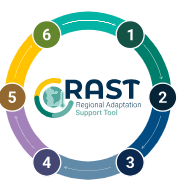
Use the RAST
Use the Regional Adaptation Support Tool (RAST), as a framework for integrating health across the full adaptation planning cycle, including climate risk assessments, identifying, assessing, selecting adaptation options, implementing adaptation, whether health sits in a dedicated climate adaptation strategy or in other plans, such as spatial plans.
Give health a clear place in governance
Climate-health adaptation needs clear leadership, defined roles, cross-sectoral coordination and adequate resources. There's no single governance model: authorities can build on existing structures, as in Wales (Example 2.1), or set up a dedicated coordination mechanism, as in Flanders (Example 2.2).
Example 2.1 Wales, integrating health and wellbeing across public policy
The Well being of Future Generations (Wales) Act provides a common framework for public bodies to pursue shared wellbeing goals, including a healthier and more resilient Wales. It promotes collaboration, a long term and integrated approach, participation and prevention. At local level, Public Services Boards bring together local authorities, health boards, fire and rescue authorities and Natural Resources Wales to assess local wellbeing and develop joint plans.
Source: Well-being of Future Generations (Wales) Act 2015
Example 2.2 Flanders, Belgium, dedicated climate health coordination
Flanders has established a working group bringing together actors from health, environment and other policy areas, alongside local authorities, primary care and other stakeholders. It aims to strengthen cross sectoral collaboration and provide a common basis for coordinating climate health risks, responsibilities and action.
Source: WHO, 2026a
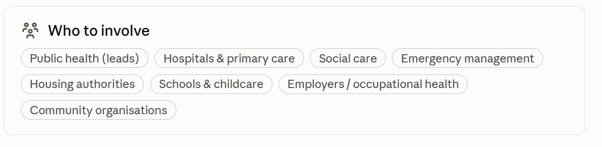
An inclusive and participatory approach should be part of this from the start. Stakeholder mapping can identify people with relevant expertise, responsibilities, interests or lived experience of climate-related health risks, public health and healthcare professionals, social and care services, emergency services, community organisations, researchers, and representatives of vulnerable groups. This network should ideally be involved across the full adaptation cycle, from awareness-raising and risk assessment to implementation and monitoring.
Assess climate risk and vulnerability
Climate-health adaptation should begin with a clear understanding of how climate hazards affect health and which populations, places and systems are most at risk. Climate Risk and Vulnerability Assessments (CRVAs) can help authorities identify priority risks and vulnerable groups, set climate-health objectives, identify and select the most suitable adaptation options.
CRVAs should be based on the best available data plus local and community knowledge, and engage stakeholders to surface less visible vulnerabilities (see Example 2.3, Paris).
35 of 128
European cities had conduced a dedicated health focused risk and vulnerability assessment
Example 2.3 Paris, France, stakeholder engagement in climate health risk assessment
The IMPETUS4CHANGE project in Paris used a participatory approach to ensure its assessment of heat-related health risks responded to the needs of organisations involved in urban adaptation and planning. Stakeholders from public, voluntary and private sectors were consulted through interviews, webinars and workshops to identify priorities and information needs and to review the climate information being developed. Their input helped identify which health impacts and indicators matter locally, and how assessment results can better support adaptation decisions.
Source: JRC, 2025
Identify vulnerable groups and places
Climate related health risks are not shared equally. Age, health status, income, housing, mobility, social support, access to services and working conditions all influence how people experience climate hazards. Occupational health also matters: e.g. workers in agriculture or construction face greater exposure because of where and how they work.
Look at which groups and places are most vulnerable, not just where hazards are greatest. Combine official data with community knowledge.
Apply a justice lens. Measures that improve resilience overall may not protect those most at risk and can, in some cases, reinforce existing inequalities
Weigh co-benefits and trade-offs
Shading, greening, water-sensitive design and better housing protect health in multiple ways. Apply a health and equity lens from the outset so trade-offs don't become maladaptation.
Barcelona prevented displacement in its Superblock programme by pairing new green spaces with strict social housing protections (EEA, 2025a).
France limits energy poverty risk by capping renovation-related rent increases at 15% of costs (EEA, 2025a).
- Padova diverts water between river branches to balance flood pressure, showing protection in one place can shift hazard to another (Mela et al., 2020).
Prepare climate-health projects that can attract funding
Prepare investment-ready projects and combine funding sources rather than relying on adaptation budgets alone — climate-health investment spans public health, housing, planning, social care, education and disaster risk management (see Example, 2.5 Bilbao and 2.6, Paris).
2/3
of authorities need more funding for climate-health adaptation planning
Example 2.5 Bilbao, Spain Financing urban resilience through a public-private partnership
Bilbao used a public-private partnership to redevelop the flood-prone Zorrotzaurre peninsula, combining public and private investment of more than EUR 21 million. Alongside flood risk reduction, the project supported wider urban regeneration, including green and public spaces that contribute to a healthier urban environment. The project is expected to reduce potential flood damages by 31-100%, depending on flood severity. It illustrates how adaptation measures with health co-benefits can be financed through partnerships that combine public and private resources.
Source: Committee of the Regions, 2024.
Example 2.6 Paris, France, long term financing for cooling at city scale
Hamburg's Green Roof Strategy combines a city wide target with financial incentives, regulation, stakeholder engagement and technical support, aiming for 100 hectares of green roofs including greening at least 70% of new buildings and suitable renovated roofs. The strategy shows how planning requirements and financial support can increase uptake at scale.
Source: Climate-ADAPT, 2023
Tailor measures and communication
Identify predictable gaps in protection: accessible and multilingual communication, targeted outreach, welfare checks, support for schools and care homes, and trusted intermediaries such as pharmacists and social workers (see Example 2.7, Drenthe).
Example 2.7 Drenthe, Netherlands, making climate risk information locally relevant
Drenthe's Adaptation Picture is a regional StoryMap presenting climate risks, impacts and adaptation options through accessible visual information. It shows how tailored visualisation can translate complex climate data into locally relevant content for different stakeholders, supporting dialogue and informed adaptation decisions.
Source: MIP4Adapt, 2024a
Mainstreaming climate-health into spatial planning and the built environment
Spatial planning and built environment policies concerning urban design, housing, transport are central to progressing climate-health adaptation. They are core competences of local and regional authorities. Adopting a resilience-by-design approach considers climate risks, health impacts, vulnerable groups and long-term spatial choices together from the outset.
Steer development away from hazard-prone areas
Weigh current and future exposure to flooding, wildfire, landslides, coastal erosion and heat, alongside how location and design affect health (see Example 3.1, Noordwijk). Use compact, mixed-use neighbourhoods, healthy placemaking and 15-minute-city concepts to cut exposure while generating wider health benefits (see Example 3.2, Toulouse and Example 3.3, Stuttgart). Apply Health Impact Assessment before planning decisions are made (see Example 3.4, High Path Estate). For existing neighbourhoods, retrofit through greening and shading, reducing sealed surfaces, and improving water management (see Example 3.5, Vienna).
Example 3.1 Noordwijk, Netherlands, planning for future climate risks
In planning the Bronsgeest new district, Noordwijk assessed future risks from waterlogging, drought and heat stress before defining spatial and design requirements. Assessing climate risks before setting design requirements, rather than after development decisions have been made, helps ensure safe and healthy living conditions from the outset.
Example 3.2 Toulouse, France, refreshing the city
Through its Toulouse + fraîche plan, the city developed and tested measures to reduce urban heat stress: shading, greening, soil desealing, lighter coloured surfaces, improved water management and changes to public spaces and municipal activities. Together, these measures reduce heat exposure and improve thermal comfort while improving the quality of public spaces.
Source: MIP4Adapt, 2024b
Example 3.3 Stuttgart, Germany, green blue infrastructure for cooling and air quality
Stuttgart uses green ventilation corridors, parks and green spaces to improve air circulation and address both heat and air pollution risks. Spatial planning helps protect these ventilation pathways and integrate them into the wider urban structure, showing how green infrastructure and land use planning can work together in areas where heat and air pollution overlap.
Source: Climate ADAPT, 2020
Example 3.4 High Path Estate, Merton, healthy and climate resilient regeneration
The regeneration of the High Path Estate used a Health Impact Assessment to inform the local plan and identify how regeneration could improve health and reduce inequalities. The assessment considered accessibility and active travel, access to green and open space, social infrastructure, employment, food growing, and air and noise pollution. The approach shows how health can be embedded in regeneration from the planning stage, with attention to the needs of the existing community.
Source: TCPA, 2018
Example 3.5 Vienna, Austria, integrating climate resilience into urban planning
Vienna uses climate data and vulnerability assessments to inform new development and neighbourhood re-design. Measures include trees and shaded streets, green spaces and roofs, permeable surfaces, water sensitive design and climate-adapted building requirements. Investment in flood retention infrastructure and the New Danube flood bypass has reduced the risk of flooding affecting homes, services and infrastructure.
Source: MIP4Adapt, 2024c
Make housing and renovation part of a healthy-homes approach
Take a healthy-homes approach — link housing policy, building standards, renovation programmes and rental regulation to health and climate resilience. Address overheating and thermal comfort (external shading, natural ventilation, passive cooling, green infrastructure, sustainable drainage), alongside affordability, accessibility and energy poverty. In retrofit programmes, prioritise climate-vulnerable and socially disadvantaged households, and pair home improvements with neighbourhood-level access to trees, green space, services and safe walking/cycling routes.
Overheating
is an increasing concern, particularly for lower income households, renters and people living in Central Eastern or Southern Europe
(EEA-EF, 2026).
Example 3.6 Stiefingtal, Austria, climate resilient building guidelines
Stiefingtal developed local building guidelines for new construction and renovation covering shading, passive cooling, natural ventilation, energy efficiency and protection from climate hazards. Developed with local stakeholders and technical experts, the guidelines provide practical direction for municipalities, planners and builders.
Source: MIP4Adapt, 2024d
Example 3.7 Reggio Emilia, Italy, passive cooling in social housing
Two social housing buildings in Reggio Emilia were retrofitted with ventilated and air permeable roofs to reduce heat gains and improve summer thermal comfort. Monitoring showed lower ceiling temperatures and reduced cooling energy use, demonstrating how passive cooling can be integrated into housing retrofit programmes to reduce overheating and reliance on mechanical cooling.
Source: Climate ADAPT, 2026
Example 3.8 Ghent, Belgium and Basque Country, Spain, one stop shops for equitable renovation
In Ghent, De Energiecentrale provides personalised renovation advice and support to vulnerable, low-income households residing in private dwellings, specifically single-family homes and condominiums. It includes financial and administrative guidance, working with social partners to reach households facing barriers (financial, administrative, logistical, access) to renovation. In the Basque Country, Opengela combines technical, financial and administrative support through neighbourhood offices, with outreach in deprived areas. Both cases show how integrated, locally accessible support can make climate resilient renovation more accessible to households most at risk.
Source: ETC ST, 2025
Protect schools, care homes, and healthcare facilities
Treat schools, care homes and healthcare facilities as priority sites. Assess exposure to hazards, resilience of buildings and access routes, and ability to maintain essential services during extreme events. Avoid siting new facilities where climate risk can't be adequately mitigated; for existing ones, address both physical resilience and continuity of care. Build climate and health considerations in from siting through design, renovation and operation.
The heat exposure of schools data viewer explores the probability of high temperatures during the school year, now and in the future, across Europe (see Box 3.1).
900,000+
pupils had education disrupted by heatwaves in 2024
(European Climate and Health Observatory, 2026)
Box 3.1 Heat in Europe's schools: a growing threat |
|---|
Extreme heat is increasingly disrupting the school calendar. Educational facilities require urgent adaptation to protect pupils and teachers:
|
Example 3.9 Poznań, Poland, climate resilient and healthy schoolyards
Poznań is transforming schoolyards and kindergarten grounds by replacing sealed surfaces with trees, permeable and green areas, rain gardens and natural play spaces. These measures reduce heat and improve rainwater management while creating better spaces for play, outdoor learning and contact with nature. Projects involve students, teachers and parents, linking climate adaptation with children's health and wellbeing.
Source: MIP4Adapt, 2024e
Cooling spaces and heat shelters
Identify suitable locations (libraries, museums, community centres, parks). Mapping alone isn't enough. Spaces must be open when needed, adequately equipped, accessible, and kept up to date, particularly for seasonal facilities.
Example 3.10 Valencia, Spain, Climate Shelters Network
Valencia has developed a network of climate shelters using existing facilities such as libraries and social service centres. Sites are assessed for thermal comfort, accessibility and basic amenities. The initiative combines mapping, stakeholder engagement, pilot testing and public communication, showing how authorities can plan cooling provision as a network rather than relying on ad hoc responses during heatwaves.
Source: EU Covenant of Mayors, 2025
Example 3.11 Warsaw, Poland — cooling spaces and heat preparedness
Warsaw has created a network of 150 publicly accessible cooling spaces in municipal buildings across the city. The spaces are open to all residents and are listed by district, with opening hours published online and in a city map viewer. The initiative shows how local authorities can combine heat preparedness with trusted public services, using libraries, cultural centres, sports facilities, social services and municipal offices as places of refuge during hot weather.
Source: Warszawa 19115, 2026
Keep essential journeys possible in extreme weather
Use spatial planning, street design and transport policy to keep essential journeys possible during extreme weather.
Shaded and accessible walking/cycling routes, drinking water points and rest areas, climate-resilient transport stops, flood-resilient access routes, and reliable emergency access. Risk is greater for older people, children, people with disabilities, low-income households and residents of poorly connected areas (EEA, 2026a).
17.2%
is the average tree canopy cover along cycling routes, rising to 30.5% across 885 European cities
(Chen-Xu et al., 2026, Lancet Countdown in Europe Cities).
Example 3.12 Vienna, Austria, climate adapted public transport stops
Vienna tested green roofs on bus stops to reduce heat exposure for passengers. Measurements showed stops around 1 to 1.5°C cooler than conventional stops, illustrating how small changes to transport infrastructure can improve thermal comfort and support safer mobility during heat.
Source: MIP4Adapt, 2025
Green and blue infrastructure (GBI) and nature-based solutions (NbS)
Green and blue infrastructure protects health only where it reaches the people who need it most. Cooling, flood resilience, air quality and wellbeing benefits depend on where, how and for whom it's designed.
Opportunities for action for local and regional authorities
Cool streets, squares and routes people depend on
Trees, parks, shaded streets, green corridors and water features reduce temperatures, especially in dense, sealed areas (see Example 4.1, Barcelona and Example 4.2, Hamburg). Move from single projects to systematic investment: measurable green-space targets, regulation paired with incentives, green requirements built into development decisions (see Example 4.3, Berlin and Example 4.4, Vienna).
<50%
of Europe's urban residents live within 300m of green space
(European Climate and Health Observatory, 2025)
Example 4.1 Barcelona, Spain, targets, trees and equitable cooling
Barcelona's Superblock programme combines reduced traffic with more trees, green space and shade in dense neighbourhoods. The city has set a target to increase green space per inhabitant by 1 m² between 2016 and 2030, with attention to areas with limited green space and greater vulnerability. Modelling estimated the programme could reduce ambient temperatures by up to 1.2°C on hot days.
Source: Climate ADAPT, 2025
Example 4.2 Hamburg, Germany, green roofs as a city-wide policy
Hamburg's Green Roof Strategy combines a city wide target with financial incentives, regulation, stakeholder engagement and technical support, aiming for 100 hectares of green roofs including greening at least 70% of new buildings and suitable renovated roofs. The strategy shows how planning requirements and financial support can increase uptake at scale.
Source: Climate ADAPT, 2022
Example 4.3 Berlin, Germany, making green infrastructure a planning requirement
Berlin's Biotope Area Factor (BAF) embeds a minimum proportion of ecologically effective green surfaces into development requirements, achievable through trees, vegetation, green roofs and permeable surfaces, with requirements varying by land use. Rather than funding individual projects, the BAF makes green infrastructure part of new development and regeneration systematically.
Source: Climate ADAPT, 2020
Example 4.4 Vienna tested green roofs on bus stops to reduce heat exposure for passengers.
Measurements showed stops around 1 to 1.5°C cooler than conventional stops, illustrating how small changes to transport infrastructure can improve thermal comfort and support safer mobility during heat.
Source: MIP4Adapt, 2025
Design water-sensitively to manage flood risk
Use wetlands, permeable surfaces, restored streams, retention areas, green roofs and de-sealed spaces to manage stormwater while cooling streets and supporting biodiversity. Flooding damages homes, disrupts healthcare access and raises waterborne-disease risk — combined sewer overflows after heavy rain are a direct public-health concern (see Example 4.5, Copenhagen).
17.5%
of stormwater runoff could be avoided by greening 35% of EU urban surfaces
Example 4.5 Copenhagen, Denmark, multifunctional blue green infrastructure
Copenhagen's Cloudburst Management Plan uses parks, streets, retention areas and other public spaces to manage heavy rainfall while improving the urban environment. The long-term plan covers around 300 projects, combining surface-based blue-green measures with conventional drainage infrastructure to retain or direct stormwater while creating greener and more attractive public spaces. The approach shows how flood-risk management and health and wellbeing benefits can be delivered together through public-space investment.
Source: Climate ADAPT, 2016b
Support mental wellbeing, not just physical safety
Greener, cooler, attractive places support relaxation, social interaction and everyday activity — especially valuable in dense neighbourhoods with limited quality public space. Contact with nature may help wellbeing recover after climate-related events.
Consider who actually benefits before investing
Investment can concentrate in already-advantaged areas, leaving high-exposure neighbourhoods with less. Greening can also raise housing costs and displacement pressure. Make sure that affected communities are involved, where affordability is already under pressure. Poorly designed or maintained measures can create allergens or vector-borne disease risks, or reinforce inequality (see Example 4.6, Nantes and Example 4.7, Barcelona)
13.6%
of 851 cities reached 30% tree canopy by 2020; tree loss outweighed gain
Example 4.6 Nantes, France, linking greening with affordable housing
Nantes combines urban greening with measures to protect affordability. Municipal guidelines require 56% of new housing to be public or social housing, while development projects include community participation. This helps ensure that lower income residents can benefit from improved neighbourhoods without being priced out.
Source: Climate ADAPT, 2016b
Example 4.7 Barcelona, Spain, protecting residents alongside urban greening
Barcelona has combined its Superblock and Green Axes programmes with measures addressing social housing, rents, tourist accommodation and protection of local businesses. The city has sought to involve groups that can be underrepresented in planning processes and to monitor neighbourhood change, showing how greening can be combined with measures that protect affordability, local services and inclusion.
Source: EEA, 2025a
Spotlight: Heat and health
Extreme heat is Europe's leading climate threat to health. Heat-Health Action Plans is the most effective and practical tool for acting on it
~95%
of weather/climate-extreme deaths in Europe are caused by heat
(EEA, 2025b)
~70,000
heat deaths (2022), and ~48,000 (2023)
(Ballester et al., 2024)
86 of 105
cities report heat as the top health hazard
(European Climate and Health Observatory, 2026b)
46%
of urban hospitals are ≥2°C warmer than region
(EEA, 2022a)
43%
of schools are ≥2°C warmer than region
(EEA, 2022a)
7.7
days/year when UHI is over 1.5°C, avg. of 820 cities
(Lancet Countdown)
Building a Heat-Health Action Plan
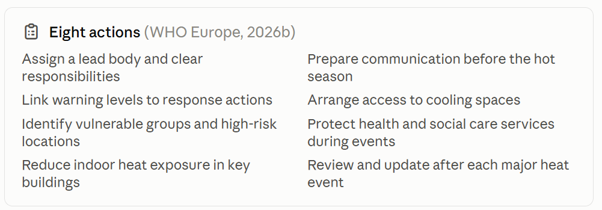
Heat-health action plans are important tools for keeping people safe during heatwaves. See example 5.1, Maribor and Example 5.2 Ludwigsburg.
Example 5.1 Maribor, Slovenia
Maribor developed a Heat Action Plan in response to rising temperatures, more frequent hot days and more tropical nights. It brings together heat risk analysis, stakeholder cooperation, communication and targeted measures for groups at higher risk, including older people, children, pregnant women, infants, outdoor workers and people with existing health conditions. The case shows how local heat risk information can anchor a plan that connects preparedness with longer term action.
Source: MIP4Adapt, 2025c
Example 5.2 Ludwigsburg, Germany
In 2024, Ludwigsburg district launched a Heat Health Action Plan covering 19 towns and 20 municipalities, led jointly by the local health office and District Medical Council. A multisectoral working group spans health, social care, hospitals, pharmacists, civil protection and education. The plan establishes a heat warning cascade and targeted actions for key stakeholders, showing how coordination can work across a complex administrative landscape.
Source: WHO, 2026b
Opportunities for action for local and regional authorities
- Prevention & long-term risk reduction
Spatial planning and building standards to reduce heat exposure · greening, tree planting, soil desealing prioritised by exposure and vulnerability · retrofit schools, care homes, hospitals and social housing · embed heat objectives in wider adaptation and housing plans - Preparedness
Develop or update a local HHAP using 2026 WHO Europe guidance · set warning thresholds linked to clear actions · identify and publicise cooling spaces · build outreach and check-in systems for people at higher risk · prepare accessible, multilingual communication in advance · brief care homes, hospitals, schools and employers ahead of the hot season - Response
Activate the HHAP when thresholds are reached · coordinate health, social care and emergency services · maintain continuity of care · keep cooling spaces open throughout the event · use outreach and welfare checks for isolated people - Recovery
Review and update the plan after each major event · monitor disruption to medication, treatment and ongoing care · identify gaps in service continuity · carry lessons learned into next season's plan
Spotlight: Flooding and health
Flooding is often treated as an infrastructure problem. It can harm health directly and indirectly, and local and regional authorities shape exposure, service continuity and who gets protected.
#2
flooding is the second most-reported hazard affecting health, after heat
(European Climate and Health Observatory, 2025)
4,668
deaths in Europe were caused by flooding between 1980-2024
(EEA, 2025)
340,000+
were displaced due to flooding between 2008–2024
(IDMC, 2025)
47%
of cities report flood health impacts
(CDP, 2024)
Opportunities for action for local and regional authorities
- Prevention & long-term risk reduction
Prevent development in flood-risk areas · require flood risk assessments · sustainable drainage and water-sensitive design · protect hospitals, care homes and schools · support property-level resilience · consider managed retreat where risk can't be reduced in place - Preparedness
Map exposed communities with local knowledge · test plans with health, social care and utilities · make warnings and evacuation inclusive for reduced mobility or language barriers · set continuity arrangements for care providers · require site-level plans for new developments - Response
Issue clear warnings linked to predefined actions · assign responsibility for reaching people who need help · maintain care access with contingency for staff, transport, power, water · coordinate across administrative boundaries - Recovery
Targeted mental health support, prioritising displaced people, children and older people · monitor disruption to medication and care · prioritise safe housing for the most vulnerable · review and update before the next event
Example 6.1 Navarra, Spain
After severe flooding, 17 municipalities in Navarra developed customised flood self protection plans. Each plan defines local responsibilities, organises available resources and links early warning to emergency response. Digital monitoring tools, mass SMS alerts and social media communication are integrated into the approach. Plans are regularly evaluated and updated, and connect to the region's wider civil protection framework. The case shows how authorities can translate flood warnings into clear local action, and how cross municipal coordination can strengthen resilience where risks cross administrative boundaries.
Source: MIP4Adapt, 2024g
Example 6.2 Emilia Romagna, Italy
After the severe 2023 floods and landslides, the regional health system deployed psychological support teams, set up hubs in shelters and established a telephone support service. Older people, children, people with disabilities and those with psychiatric conditions were prioritised. The case shows why recovery planning must include mental health alongside infrastructure repair, and why targeting support to vulnerable groups matters.
Source: Climate-ADAPT, 2024
Example 6.3 Augustenborg, Malmö, Sweden
Augustenborg, a socially and economically disadvantaged neighbourhood, had recurrent flooding because its drainage system could not cope with heavy rainfall. As part of a wider regeneration programme, Malmö introduced an open sustainable drainage system with 6 km of channels, ten retention ponds, wetlands and more than 11,000 m² of green roofs. Flooding was substantially reduced and the neighbourhood gained new green and recreational spaces.
Source: Climate-ADAPT, 2024
References
Language preference detected
Do you want to see the page translated into ?
Exclusion of liability
This translation is generated by eTranslation, a machine translation tool provided by the European Commission.
Exclusion of liability
This translation is generated by eTranslation, a machine translation tool provided by the European Commission.