All official European Union website addresses are in the europa.eu domain.
See all EU institutions and bodies
An official website of the European Union | How do you know?
Environmental information systems
EN


Key messages

- The exposure to climate risk drivers reflects an uneven vulnerability across EU regions and sectors but also a concentration in specific financial sector portfolios, banks and financial institutions.
- Sustainable investments into climate change adaptation and mitigation are harmonised in an EU taxonomy that needs to cover more economic activities over time and is globally applicable. Via such sustainable investments, the financial sector can promote and support adaptation measures to reduce physical climate risks such as property damage due to a flood. Residual risks can to a large degree be transferred via insurance mechanisms.
- Insurance is vital for mitigating the economic impacts of climate disasters by funding reconstruction and covering losses. However, on average less than 20% of Europe's climate-related losses from 1980-2024 were insured; in some regions this figure may be even much lower (Economic losses and insurance protection gap in the period 1980-2023), highlighting a significant protection gap which – as climate change progresses – may widen even more. Addressing this issue is crucial and will involve the cooperation and coordination between different actors including public authorities and the financial industry.
Why climate change adaptation matters for the Financial sector
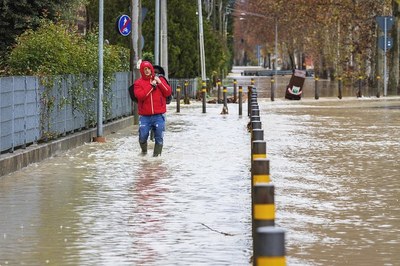
Climate change poses significant macroeconomic and fiscal risks to the EU causing significant losses in Europe. It can damage economic performance, reduce tax revenues, and increase government spending on disaster recovery and social costs. These impacts threaten fiscal stability, disrupt trade flows, damage capital stock, lower productivity, and reduce labour supply. Thus they can ultimately hinder economic growth and increase financial uncertainty. For instance, the 2021 floods in Germany, Belgium, and the Netherlands cost EUR 44 billion. These impacts strain public finances, insurers, investors, and financial markets. Economic costs are expected to rise sharply in the coming decades, driven by both direct climate change impacts and international effects cascading back to Europe.
Between 1980 and 2024, weather- and climate-related extremes amounted to an estimated EUR 822 billion (2024 values) in damages. A relatively small number of events is responsible for a large proportion of the economic losses: 5 % of climate-related events with the biggest losses were responsible for 59% of losses, and 1% of the events caused 37% of losses. The average annual (constant 2024 EUR prices) economic losses were around EUR 8.6 billion in 1980-1989, EUR 14.9 billion in 1990-1999, EUR 16.5 billion in 2000-2009, EUR 19.7 billion in 2010-2019 and EUR 44.9 billion for the period 2020-2024 (Economic losses and insurance protection gap in the period 1980-2023).
The first European Climate Risk Assessment identified several major climate risks relevant for the financial sector. The risk of the viability of the European solidarity mechanisms requires urgent action. The risk to public finances leading to a financial crisis and the risk to European property or insurance markets require more action. Finally, the risks to European financial markets from climate impacts in Europe and beyond need further investigation.
Explore further











External links
Language preference detected
Do you want to see the page translated into ?
Exclusion of liability
This translation is generated by eTranslation, a machine translation tool provided by the European Commission.
Exclusion of liability
This translation is generated by eTranslation, a machine translation tool provided by the European Commission.