All official European Union website addresses are in the europa.eu domain.
See all EU institutions and bodies
An official website of the European Union | How do you know?
Environmental information systems
EN


Non-climatic risk drivers are the social, economic, environmental, technological and institutional conditions that influence climate risk by shaping exposure and vulnerability. Understanding these drivers helps explain why the same climate-related hazard can have very different consequences across societies, economies and ecosystems.
Key messages
Climate risks are shaped not only by a changing climate, but also by how societies, economies and ecosystems function and develop.
Non-climatic risk drivers (NCRDs) are processes or conditions that influence how strongly people, ecosystems and economic activities are affected by climate hazards. They include factors such asdemographic change, land use, urbanisation, soil sealing, ecosystem degradation, social inequality, governance capacity, economic instability, ageing infrastructure, technological lock-ins and supply-chain dependencies.
Non-climatic risk drivers can increase or reduce exposure and vulnerability. How and where land is used, for example, can substantially influence climate risk. Urban development and soil sealing can increase exposure to heat and reduce the capacity of soils to absorb heavy rainfall. Healthy ecosystems can provide natural protection against flooding, heat and drought. Similarly, ageing populations or social inequalities can make groups more vulnerable to climate change impacts.
Climatic and non-climatic drivers interact to determine the severity of climate risks. Evidence from the European Climate Risk Assessment shows that risks can become more severe as climatic hazards intensify, but also because changes in land use, ecosystems, demographics, infrastructureand economic conditions increase exposure or vulnerability through the weakened system resilience. These factors can interact across sectors and regions, contributing to compound and cascading risks.
Non-climatic risk drivers can be influenced through policy and planning. Unlike many physical climate drivers, NCRDs are often shaped by human decisions. Spatial planning, ecosystem restoration, social and public health policies, infrastructure investment, economic can directly reduce exposure and vulnerability, making NCRDs powerful levers for climate change adaptation.
Understanding these drivers helps identify where adaptation can tackle the underlying conditions that make climate impacts more severe. Both the data infrastructure and the methodological framework are in place to incorporate quantitative NCRDs (such as demographic structure, urbanisation, and inequality) into Shared Socioeconomic Pathways (SSP)‑aligned, scenario‑based climate‑risk assessments.
Non-climatic drivers can trigger cascading impacts across sectors and regions, amplifying compound and tail-risk events. Accounting for these interactions is essential for realistic risk storylines and effective adaptation planning.
Figure: Examples of non-climatic risk drivers. Click on the image to access the interactive dashboard.
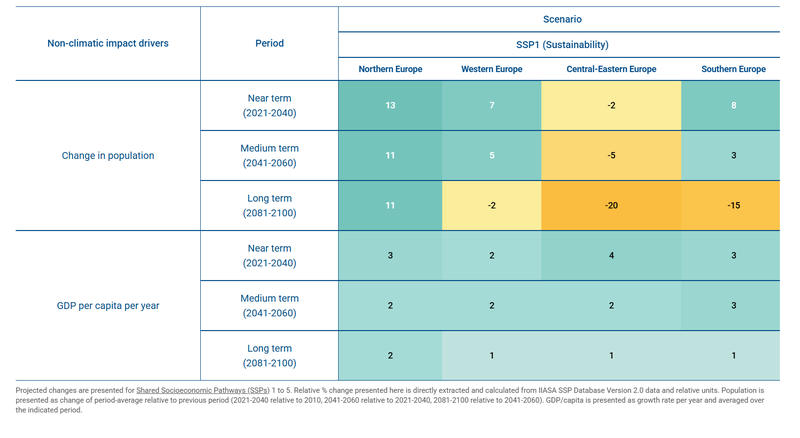
Note: Non-climatic risk drivers referred to here as ‘non-climatic impact drivers’ used in the first European Climate Risk Assessment.
Source: Climate-ADAPT: Impact drivers
Why non-climatic risk drivers matter for climate change adaptation
Understanding non-climatic risk drivers helps identify why and where climate-related hazard may cause the largest impacts, and where adaptation can reduce risk most effectively. Adaptation can influence many of these underlying conditions – for example through policy reform,spatial planning and cross-sectoral coordination of interventions, infrastructure upgrades and social measures. Considering non-climatic drivers alongside climatic change therefore supports more targeted, equitable and forward-looking adaptation decisions.
Explore further





External links
Language preference detected
Do you want to see the page translated into ?
Exclusion of liability
This translation is generated by eTranslation, a machine translation tool provided by the European Commission.
Exclusion of liability
This translation is generated by eTranslation, a machine translation tool provided by the European Commission.