All official European Union website addresses are in the europa.eu domain.
See all EU institutions and bodies
An official website of the European Union | How do you know?
Environmental information systems
EN


Key messages

- Climate change is increasingly affecting the transport sector through more frequent and severe extreme weather and hydrological events, including intense rainfall, storms, storm surges, flooding, wildfires, heatwaves and strong winds. These hazards pose significant risks to transport infrastructure, disrupting mobility, reducing reliability, and compromising safety across transport networks.
- Under the EU Adaptation Strategy, adaptation measures in the transport sector are being implemented in synergy with broader European Green Deal initiatives, notably the Sustainable and Smart Mobility Strategy. Together with its accompanying Action Plan, this framework sets out a pathway towards a greener, smarter and more climate-resilient European transport system. A key priority is the climate-proofing of the Trans-European Transport Network (TEN-T) and other EU-funded transport infrastructure. The European Environment Agency supports these efforts through assessments and reporting on transport-related climate risks and adaptation measures.
- Ensuring that transport infrastructure remains safe and fit for purpose under changing climatic conditions also requires the continuous updating of technical standards. To this end, the EU is working closely with the European Standardisation Organisations to integrate climate resilience considerations into infrastructure design, construction and operation.
Why climate change adaptation matters for the Transport sector
Transport is a cornerstone of Europe's economy and society, enabling the movement of people and goods and supporting economic activity, social cohesion and public services. Strengthening the resilience of transport systems to climate change must therefore go hand in hand with efforts to decarbonise transport and accelerate its transition towards sustainability and digitalisation.
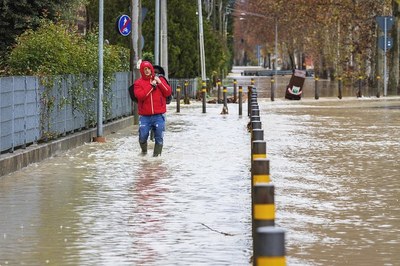
Climate change affects all transport modes through a growing range of climate hazards. Increased frequency and intensity of extreme weather events — including heavy precipitation, storms, flooding, wildfires, heatwaves and sea-level rise — can damage infrastructure, disrupt operations and reduce the safety and reliability of transport services.
The first European Climate Risk Assessment identifies risks from pluvial, fluvial and coastal flooding to land-based transport infrastructure as among the most urgent climate risks facing Europe. However, road, rail, inland waterway, maritime and aviation systems are all exposed to climate-related hazards. The assessment further highlights the interconnected nature of transport networks and other critical infrastructures, meaning that disruptions in one location can trigger cascading impacts across regions and sectors.
For example, extreme weather events can interrupt transport services, limiting access to healthcare, emergency response and essential services. Similarly, prolonged periods of low river flows can impede inland navigation, with knock-on effects on supply chains, industrial production and energy systems. Building a climate-resilient transport sector is therefore essential not only for maintaining mobility, but also for safeguarding Europe's economic resilience, competitiveness and societal well-being.
Explore further












External links
Language preference detected
Do you want to see the page translated into ?
Exclusion of liability
This translation is generated by eTranslation, a machine translation tool provided by the European Commission.
Exclusion of liability
This translation is generated by eTranslation, a machine translation tool provided by the European Commission.