All official European Union website addresses are in the europa.eu domain.
See all EU institutions and bodies
An official website of the European Union | How do you know?
Environmental information systems
EN



Climate change alters the distribution and activity of disease-carrying vectors like mosquitoes, ticks, and sandflies in Europe. Warmer temperatures have enabled outbreaks of dengue, chikungunya, West Nile fever, and tick-borne diseases in new regions. Future warming is expected to expand vectorborne disease risks northward, especially under high emissions scenarios.
Health issues
Climate change is changing the way some diseases are transmitted in Europe, especially those spread by vectors like ticks and mosquitos. Higher temperatures, changes in rainfall, milder winters, and shifts in ecosystems affect the activity, numbers, and areas where these vectors live. This means that the diseases they carry can appear in areas where they were rare or never seen before. The European Centre for Disease Prevention and Control (ECDC) provides regular updates on the geographic distribution of these vectors in Europe, as well as on the occurrence of the diseases they transmit in EU/EEA.
The following tables are a non-exhaustive list of vector-borne diseases divided into mosquito and tick-borne diseases.
Mosquito-borne diseases
Tick-borne diseases
Observed effects
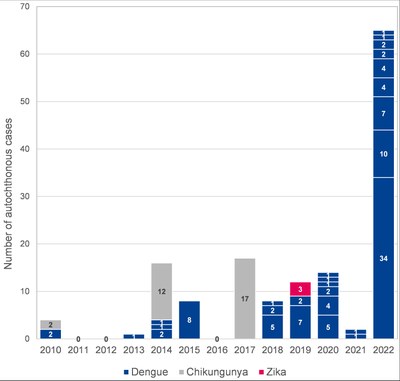
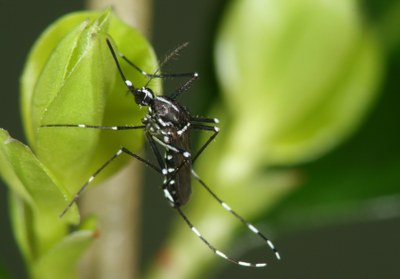
Climate change is no longer a future threat, it is a current one, and it is actively reshaping the landscape of infectious diseases across Europe (EEA, 2022). We are witnessing a "new normal" where tropical diseases are being locally transmitted in Europe. Invasive vectors, such as the Asian tiger mosquito (Aedes albopictus), are now established across the continent, pushing northward and into higher altitudes where they could not previously survive (World Mosquito Day 2025: Europe sets new records for mosquito-borne diseases).
The evidence is clear: record-breaking numbers of locally-acquired cases of West Nile virus infection and chikungunya virus disease are surfacing in regions once considered safe (Wadman, 2025). This shift is driven by biological adaptation: mosquitoes are developing "cold-hardiness" to survive European winters, while viral pathogens are mutating to spread more efficiently within our local environments (Delwel and Mordecai, 2025). To protect European citizens, political urgency and integrated surveillance are now paramount to managing these expanding health risks (Regulation (EU) 2022/2371 on serious cross-border threats to health).
Mosquito-borne diseases
Tick-borne diseases
Projected effects
Tiger mosquito climatic suitability in 2041–2070 under a high-emission scenario
(Click the map to see the interactive version)

The Tiger Mosquito Climatic Suitability index is relevant to human health. The tiger mosquito (Aedes albopictus) is an invasive species from south-east Asia favoured by a warmer climate and represents a serious threat as it transmits vector-borne diseases such as dengue and chikungunya. Environmental factors, among which weather conditions, affect both the potential presence and seasonal activity of the tiger mosquito. Here an example for the mid‑century (2041–2070) projections of Tiger mosquito suitability in EU countries under a high‑emission scenario (RCP 8.5).
Source: Copernicus Climate Change Service (C3S)
Rising temperatures, milder winters and shifting precipitation are already lengthening mosquito seasons and expanding Aedes and Culex populations in Europe. On Mosquito day (Aug 20), 2025, ECDC stated that hotter and longer summers and changes in rainfall are creating a “new normal” of longer and more intense transmission seasons for mosquito-borne diseases, with West Nile virus and chikungunya virus being detected in new areas and outbreaks reaching record numbers (https://www.ecdc.europa.eu/en/news-events/world-mosquito-day-2025-europe-sets-new-records-mosquito-borne-diseases). ECDC’s guidance on Aedes-borne diseases, likewise, warns that climate change will lengthen favourable environmental periods for Aedes mosquitoes, raising the potential for dengue, chikungunya virus disease and Zika virus disease outbreaks in the European continent.
The Lancet Countdown Europe reports that climatic suitability is increasing for West Nile virus, dengue virus, chikungunya virus, Zika virus and Plasmodium parasites (causing malaria), suggesting that warming climates will allow these pathogens to persist farther north and for longer each year (Van Daalen et al. 2024).
But climate change is not only affecting mosquito-borne diseases. WHO Europe’s assessment of Lyme borreliosis shows that ticks have already expanded to higher latitudes and altitudes in Europe and that future warming is likely to facilitate further spread while reducing occurrence in areas that become too hot and dry (https://www.who.int/publications/i/item/9789289022910).
Policy responses
EU policy on vector-borne diseases (VBDs) has progressively shifted from a largely reactive approach—focused on responding to outbreaks as they occur—to a more proactive and integrated framework that reflects the “new normal” of climate-driven health risks. Rising temperatures, biodiversity loss, and ecological disruption, along with globalisation, are expanding the geographic range and seasonal transmission windows of vector-borne pathogens. In this context, the EU has increasingly embedded VBD preparedness within the broader vision of the European Health Union, which aims to strengthen long-term resilience and coordinated action across Member States rather than relying on temporary containment measures (https://commission.europa.eu/topics/public-health/european-health-union_en).
A key pillar of this evolving strategy is improved preparedness through investment in innovation and health security, such as an EU joint action for the scaling up of Member States’ national systems for vector threat detection and control capacities. This joint action will establish interdisciplinary programmes to monitor vector distribution and population dynamics and will develop and implement countermeasures for the control of disease-transmitting vectors, including physical, biological, and chemical methods, complemented by public outreach campaigns.
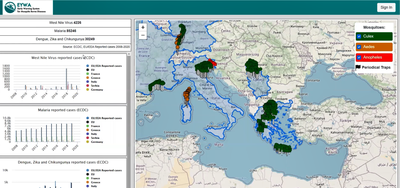
At the operational level, EU policy is also advancing toward integrated vector surveillance and control. Rather than focusing only on human clinical cases, the EU promotes a One Health-informed approach that incorporates animal surveillance (through The European Food Safety Authority (EFSA) mission), and entomological monitoring. The ECDC-EFSA funded project VectorNet plays a central role in collecting and sharing data on mosquito, tick, and other vector populations across Europe, enabling earlier risk detection and more targeted interventions before outbreaks spread widely (https://www.vectornetdata.org/).
Scientific coordination between EU agencies further strengthens this integrated framework. EFSA, particularly through its Panel on Animal Health and Welfare, provides independent scientific advice on zoonotic vector-borne diseases that affect animals (https://www.efsa.europa.eu/en/topics/topic/vector-borne-diseases). EFSA works closely with ECDC to share surveillance information and both agencies jointly administer the One-Health VectorNet network and project on vectors of veterinary and public health relevance.
Together, based on data collected by Member States, EFSA and ECDC join forces to assess the emergence of West Nile virus in Europe and produce joint monthly reports on infections in humans and animals, supporting evidence-based policymaking and reinforcing cross-sectoral cooperation at the heart of the EU’s VBD strategy.
In parallel to these institutional and regulatory developments, the EU is also strengthening its scientific and operational foundations for climate‑related health threats through the European Climate–Health Cluster (Climate Health), a Horizon Europe cooperation that brings together six major research and innovation projects: BlueAdapt, CATALYSE , CLIMOS, HIGH Horizons, IDAlert and TRIGGER. Working collectively, these projects generate evidence, data, surveillance tools, and early‑warning capacities that directly support EU preparedness for vector‑borne and other climate‑sensitive diseases. The Cluster promotes synergies across environmental, climate, and health research communities, improves science‑policy translation, and develops harmonised indicators and modelling approaches that help anticipate emerging risks rather than respond to them reactively. By feeding cutting‑edge scientific knowledge into initiatives such as the European Health Union, HERA, and the EU Strategy on Adaptation to Climate Change, the Climate–Health Cluster acts as a bridge between research, policy, and practice—strengthening the EU’s ability to forecast threats, guide targeted interventions, and build long‑term resilience in a rapidly changing climate.
Related resources

References
Language preference detected
Do you want to see the page translated into ?
Exclusion of liability
This translation is generated by eTranslation, a machine translation tool provided by the European Commission.
Exclusion of liability
This translation is generated by eTranslation, a machine translation tool provided by the European Commission.