All official European Union website addresses are in the europa.eu domain.
See all EU institutions and bodies
An official website of the European Union | How do you know?
Environmental information systems
EN


Key messages
- There is a clear need to ramp up justice considerations in adaptation. From the local to the global scale, the most vulnerable people and communities are most at risk from climate change impacts, have the least capacity to adapt, and are the least likely to be heard, recognized and benefit from adaptation actions.
- By integrating justice into adaptation efforts and addressing the unique needs and vulnerabilities of different social groups, policymakers can create more resilient and equitable communities that are better prepared to cope with climate-related hazards.
- This can be done by taking a ’just resilience’ approach, requiring policymakers and practitioners:
- address the uneven impacts of climate change;
- make sure that when developing adaptation responses to these impacts, individuals or social groups that are already vulnerable benefit fairly from these responses and are not disproportionately burdened (′leaving no one behind′).
- Just resilience is a key element in recent and forthcoming EU policies related to climate adaptation, including the European Green Deal policy package, the EU Adaptation Strategy and the 2025 EU preparedness union strategy which stress the need for justice to be integrated more broadly into efforts towards adaptation and societal preparedness
Just resilience - overcoming inequalities in climate risks and adaptation action
Europe is the fastest-warming continent on the planet and the EU has embarked on a clear path towards a carbon-neutral economy. However, as changes are happening already and at a faster pace than expected, it is no longer sufficient simply to mitigate CO2 emissions. Europe must increase its resilience to climate change. While adapting, it must also ensure that no one is left behind.
Socially vulnerable groups, such as older people, children, low-income groups and people with disabilities, are unduly affected by climate change. They are burdened disproportionately by its impacts and they do not always benefit fairly from (or are burdened further by) adaptation responses to those impacts.
First introduced as a concept in the 2021 EU Adaptation Strategy, European Environment Agency (EEA) takes Just Resilience to mean that policymakers and practitioners:
Reduce the unequal burden of climate risks – Certain groups and regions are disproportionally affected by climate change due to the uneven exposure of climate change, preexisting vulnerabilities, differing economic and political capabilities as well as differing access to public services and infrastructure (such as adequate housing protecting from flooding and extreme temperatures). A 2018 EEA report provides further insights into inequalities in vulnerability and exposure to climate hazards.
Ensure equity in the distribution of benefits (and burdens) of adaptation - When developing adaptation responses to these impacts, there is a need to make sure that individuals or social groups that are already vulnerable benefit fairly from these responses and are not disproportionately burdened (′leaving no one behind′). Adaptive measures and policies do not necessarily benefit everyone to the same extent, and in some cases may even lead to ‘maladaptation’. For instance, adaptation investments (e.g., green areas, flood insurance, local water saving or cooling measures) which do not ensure affordability can exclude low-income households. An 2025 EEA report explores this more fully, also sharing examples of how these negative outcomes can be avoided.
To enable justice in adaptation efforts, policymakers need to address the systemic and structural issues that perpetuate inequalities, focusing on transforming the underlying causes of these injustices. For example, one such issue is the weak representation of marginalized communities in decision-making forums, meaning their needs are not reflected in adaptation policies.
This requires a comprehensive approach that enhances the understanding of the uneven burden of climate change and adaptation measures among social groups. It necessitates a focus on equity aspects at all stage of adaptation planning, implementation, and monitoring, as well as at all governance levels. And it requires that attention be paid to the different dimensions of just resilience, particularly:
distributional justice (the fair allocation of resources and burdens from climate impacts and adaptation efforts);
procedural justice (fair, transparent and inclusive decision-making processes);
recognitional justice (respecting and integrating diverse values, cultures and perspectives and addressing deeper causes of inequity).
Failing to address underlying systemic inequalities and not ensuring fair access to resources and processes are likely to make existing inequalities worse. This can result in feelings of discontent and resistance to change, both which can make it harder to achieve EU policy objectives. On the other hand, incorporating justice in adaptation measures may make them more effective and is in line with EU core values and international agreements.
Policy framework
A strong policy framework with dedicated funding and support mechanisms that help these populations adapt to changing climate conditions is also essential.
There is increasing recognition of the need to ‘leave no one behind’ in all EU policy sectors, not least in climate adaptation. Just resilience is central to both the UN 2030 Agenda and the new EU Adaptation Strategy, which implements the EU Climate law. The Strategy stresses the importance of achieving resilience in a just and fair way and for adaptation measures to be designed to take social aspects into account, including international dimensions of climate risk and adaptation. It commits the European Union to support just transition through a range of policies and funding schemes, as well as via the enforcement of existing employment and social legislation.
More recent EU guidelines and strategies demonstrate the broad evolution of the notion of just resilience, including concepts such as maladaptation and social fairness.
July 2023 EC Guidelines on Member States′ adaptation strategies and plans: These guidelines, designed to support Member States in crafting their national adaptation plans, explicitly include the principle of just resilience, defined as ′preventing uneven burdens and leaving no one behind′. The guidelines emphasise maladaptation, which is directly linked to justice issues, urging Member States to prioritise socially equitable adaptation measures.
July 2024 Political guidelines for the next European Commission 2024-2029: These guidelines stress the importance of social fairness more broadly, referencing the European Pillar of Social Rights, as well as the need for a just transition. The document frames climate change as one of the greatest security risks faced by Europe and calls for climate resilience and preparedness to be stepped up.
The 2024 European Climate Risk Assessment (EUCRA), the 2024 European Commission′s communication on managing climate risks and Climate Action Progress Report and most recently the 2025 EU preparedness union strategy stress the need for adaptation strategies that prioritise and include vulnerable populations to ensure that justice is integrated more broadly into efforts towards adaptation and societal preparedness.
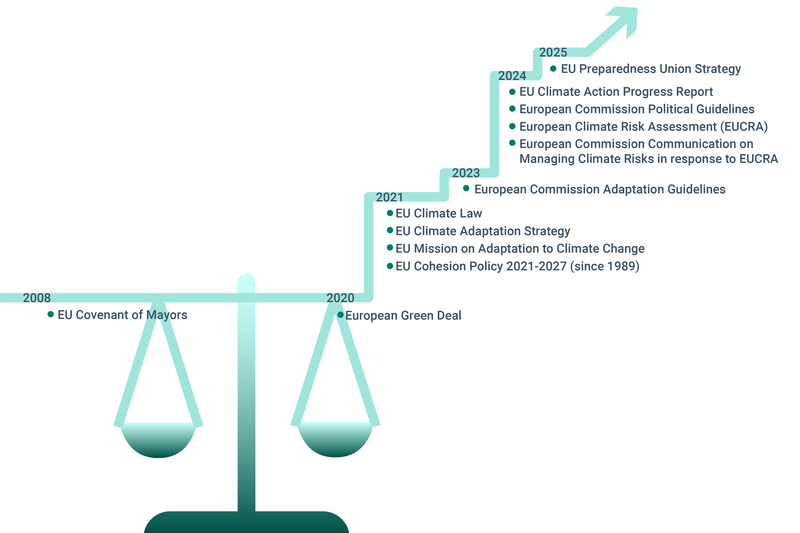
Source: EEA (2025). Social fairness in responding to climate change
Improvement of the knowledge base
Although the term 'Just Resilience' is relatively new in the climate policy landscape, there is already an established field of research on the social implications of climate change, and the knowledge base at the global and European level is growing.
Several reports specifically cover the topic, both at global and at EU levels. The 2024 European Climate Risk Assessment (EUCRA) provides a comprehensive assessment of the major climate risks facing Europe today and in the future. The EUCRA report highlights how several climate change risks are distributed across different socially vulnerable individuals or groups. Distributive justice aspects are increasingly considered in adaptation planning, but the integration of procedural and recognitional justice still remains somewhat absent.
The 5th IPCC Assessment Report (AR5) already recognized the uneven distribution of climate risks in the different sectors, and the most recent 6th IPCC Assessment Report (AR6) highlights justice as a core quality of climate adaptation at all governance levels. In particular, Working Group II contribution to the AR6 identifies principles of justice that should be considered in the evaluation of adaptation options.
The Eighth Report on Economic, Social and Territorial Cohesion presents current socio-economic and territorial disparities in Europe and how they are aggravated by climate change impacts, indicating that cohesion policy should evolve to respond to these challenges.
The 2021 ETC CA Technical paper ‘Leaving No One Behind’ in Climate Resilience Policy and Practice in Europe' explores the practical implications of the ‘just transition’ in the context of adaptation and climate resilience - ‘just resilience’. It provides insights on how to consider justice aspects in all steps of the adaptation policy cycle according to the Adaptation Support Tool. Other EEA and ETC CA products important for the understanding of just resilience consider health and urban related aspects of just resilience policies.
The EEA 2022 briefing Towards ‘just resilience’: leaving no one behind when adapting to climate change looks at how climate change affects vulnerable groups and how these impacts can be prevented or reduced through equitable adaptation actions. It also presents examples of equity-oriented policies and measures from across Europe. The 2023 ETC CA Technical Paper ‘Towards Measuring Justice in Climate Change Adaptation’ contributes to making the notion of just resilience operational, particularly by providing relevant information towards measuring progress on just resilience in the European context, including the identification of potential indicators. The EEA’s 2025 report ‘Social fairness in preparing for climate change: how just resilience can benefit communities across Europe’ deepens the discussion by providing insights on the level of national and sub-national progress regarding the integration of justice into adaptation efforts. It also explores how just resilience is addressed and implemented in four key systems: the built environment, agriculture and food, water and transport, shedding light on where adaptation measures may inadvertently make existing inequalities worse within these systems. Inspirational examples are then provided of practical approaches that are being used to ensure that no one is left behind.
The EEA also aims at tackling the consideration of justice aspects in mitigation and adaptation policies in an integrated approach. In an EEA briefing ‘Exploring the social challenges of low-carbon energy policies in Europe’, adaptation aspects are considered in the assessment of unfair impacts of carbon and energy taxes and policy analysis to maximise benefits for adaptation related objectives.
The EU also undertakes several actions to help provide policy makers and practitioners with further knowledge and methodologies to implement just resilience policies and measures. For example, the expert group on Economic and Social Impact of Research (ESIR) provides evidence-based policy advice to the Commission on how to develop fair, forward-looking and transformative research and innovation policy.
In collaboration with several EU and global partners, the European Commission and the EEA have developed the European Climate and Health Observatory. It provides access to the most relevant knowledge resources on the vulnerability of social groups to health-related climate impacts and risks as well as on justice in policy responses.
Justice in climate policies is also a key topic of the Horizon 2020 programme, especially for the mitigation of climate change. In terms of adaptation, some ongoing projects are studying the distributive implications of climate risks and related policies. For instance, the CASCADE project studies the propagation of climate risks at international level on European societies, assessing the potential socio-economic drawbacks. Policies are the focus of the NAVIGATE project, which develops new Integrated Assessment Models capable to model inequalities and to assess how mitigation and adaptation policies affect them. Moreover, the JustNature project intends to activate nature-based solutions as tools for ensuring the right to health and well-being in seven pilot cities.
The LIFE programme contributes also to the extension of the knowledge base. For example, the Evolving regions project will provide practical experience on the mapping of vulnerable groups for risk assessments and the consideration of justice aspects in municipal and regional adaptation roadmapping.
Supporting funding and investment
The EU is committed to supporting a ‘Just transition’ through dedicated funding schemes such as the Just Transition Fund.
Adaptation funding is available from various EU funding streams and many of them also support just resilience. The Multiannual Financial Framework 2021-2027 ensures that climate adaptation actions have been integrated into all the major EU spending programmes, as foreseen also in the EU Adaptation Strategy. In addition, the European Commission also provides funds through the programme Next Generation EU (€ 750 billion) to recover from the economic crisis connected with the Covid-19 epidemic. The programme funds the national recovery and resilience plans that are meant to radically transform European economies by the means of a fair climate and digital transition.
The LIFE Programme is entirely dedicated to the environment and has a budget of € 1.9 billion for Climate Action that includes climate adaptation.
Addressing inequalities in the green transition is also at the heart of the key strategic orientations of Horizon Europe (€ 95.5 billion). According to the Strategic Plan 2025-2027, the programme shall contribute, through research, to the creation of a more resilient, competitive, inclusive and democratic European society. To this end, the theme of equity in mitigation and adaptation actions cross-cuts Horizon Europe Work Programmes and in particular, ongoing and future calls will contribute to the implementation of the Mission Adaptation to Climate Change, with justice being considered in their implementation according to the objectives of the EU Mission on adaptation to climate change’.
Other relevant European funding programmes are:
- The Common Agricultural Policy (€ 378.5 billion) supports the adaptation of the agricultural sector, with particular attention to the vulnerable groups of farmers.
- The European Social Fund Plus (ESF+) is a key financing instrument to support the most vulnerable groups in Europe. ESF finances the implementation of the principles of the European Pillar of Social Rights: equal opportunities and access to the labor market; fair working conditions, and social protection and inclusion.
- The European Regional Development Fund (ERDF) may also be devoted to adaptation and the social dimension of adaptation. The funding priorities of ERDF include both “Greener, low-carbon and resilient [Europe]” as well as “More social”.
A 2024 study commissioned by the European Parliament′s Committee on Employment and Social Affairs explored numerous additional funds available for addressing the negative impacts of climate policies.
Supporting the implementation
At the European level, the just resilience is integrated and implemented through actions stemming from the European Adaptation Strategy and through other EU initiatives.
The EU Covenant of Mayors recognises the increasing need for their signatories to incorporate issues of equity and justice within their climate solutions. A 2023 guidance note 'Embedding Equity Considerations in Sustainable Energy and Climate Action Planning (SECAP), Implementation and Monitoring Processes' identifies opportunities within planning, implementation and monitoring for signatories to address different dimensions of justice within both mitigation and adaptation actions. In addition, the Covenant's 2022-2023 Policy Support Facility Pilot programme, dedicated to supporting the adaptation efforts of signatories, chose just resilience as one of its four key programme themes.
The EU Mission on Adaptation to Climate Change integrates just resilience into operationalising its objectives in different ways. It aims to support at least 150 regions to become climate resilient by 2030. Its Mission Platform has been set up to provide support tools, which are being developed via several projects. Maladaptation and justice are central concepts for these projects, including REGILIENCE, NBRACER, DESIRMED and ARCADIA which all address just resilience explicitly by ensuring adaptation efforts benefit vulnerable communities. These projects aim to promote nature-based solutions (NbS), equitable resource distribution and transformative governance. Regions4Climate, Pathways2Resilience and CLIMAAX are also working to develop just adaptation frameworks that prioritise vulnerable regions and social groups most impacted by climate change. Meanwhile, the AGORA project focuses specifically on social vulnerability to heat, while the FairFuture project will work to bring climate justice to the climate adaptation agenda.
Highlighted Resources
Highlighted Case studies
Language preference detected
Do you want to see the page translated into ?
Exclusion of liability
This translation is generated by eTranslation, a machine translation tool provided by the European Commission.
Exclusion of liability
This translation is generated by eTranslation, a machine translation tool provided by the European Commission.