All official European Union website addresses are in the europa.eu domain.
See all EU institutions and bodies
An official website of the European Union | How do you know?
Environmental information systems
EN


Just resilience ensures that climate adaptation reduces risks fairly, prioritises vulnerable groups and avoids widening existing inequalities. It places justice at the centre of adaptation planning, implementation and monitoring across all governance levels. This approach seeks to ensure that the benefits of adaptation are shared fairly and that no one is left behind.
Key messages
- Climate change does not affect everyone equally. Across Europe, vulnerable groups — including older people, children, low-income households and people with disabilities — are disproportionately exposed to climate risks and often benefit least from adaptation measures.
- Just resilience addresses this imbalance by integrating justice into climate change adaptation. It ensures that adaptation actions reduce unequal climate risks, distribute benefits fairly, and avoid placing additional burdens on those already at risk — in line with the principle of leaving no one behind.
- A just resilience approach requires policymakers and practitioners to:
- address the uneven distribution of climate impacts across social groups and regions;
ensure that adaptation measures benefit vulnerable groups fairly and do not lead to maladaptation;
embed equity considerations throughout adaptation planning, implementation and monitoring;
strengthen participation and representation of marginalised communities in decision-making.
Just resilience encompasses three complementary dimensions:
Distributional justice
- fair allocation of risks, resources and benefits
Procedural justice - inclusive, transparent and participatory decision-making;
Recognitional justice - acknowledgement of diverse needs, values and lived experiences.
Just resilience is firmly embedded in EU climate policy. It features prominently in the European Green Deal, the EU Adaptation Strategy, the first European Climate Risk Assessment (EUCRA), and the EU Preparedness Union Strategy, all of which emphasise the need to integrate social fairness into adaptation and climate resilience-building.
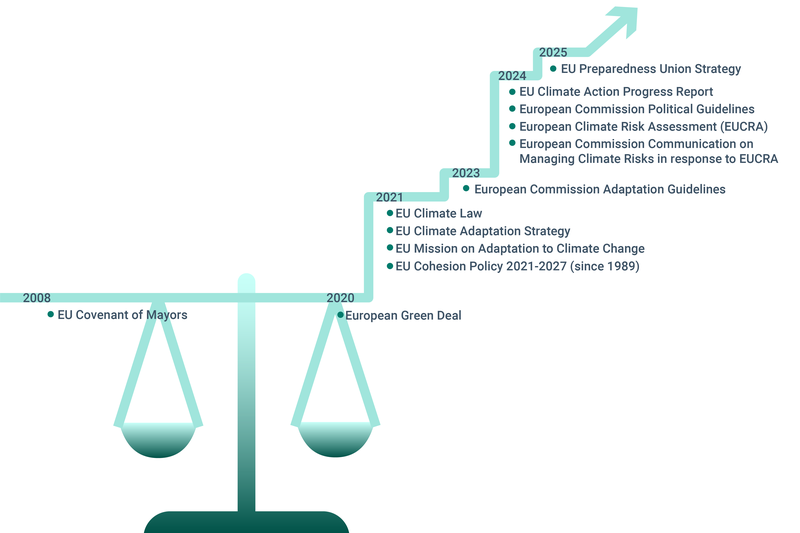
Source: EEA (2025)
Failing to address justice risks reinforcing inequalities and undermining public trust in climate policies. Conversely, just resilience can enhance policy effectiveness and support Europe’s core values and international commitments.
The EU supports a just and climate-resilient transition through major funding instruments including the LIFE Programme, Horizon Europe and NextGenerationEU. Through initiatives such as the EU Mission on Adaptation and the Covenant of Mayors, the EU also promotes equitable adaptation efforts that prioritise vulnerable communities, social inclusion and fair access to resilience-building measures across Europe.
Why just resilience matters for climate change adaptation
Adaptation measures can unintentionally worsen inequalities if social impacts are not considered. For example, green infrastructure, insurance schemes or cooling solutions may exclude low-income households. Just resilience helps avoid maladaptation by ensuring adaptation actions are socially fair, inclusive and effective. By addressing structural drivers of vulnerability and strengthening participation, just resilience improves outcomes for people most at risk, increases acceptance of adaptation policies, and strengthens Europe’s overall climate resilience.
Explore further







Language preference detected
Do you want to see the page translated into ?
Exclusion of liability
This translation is generated by eTranslation, a machine translation tool provided by the European Commission.
Exclusion of liability
This translation is generated by eTranslation, a machine translation tool provided by the European Commission.