All official European Union website addresses are in the europa.eu domain.
See all EU institutions and bodies
An official website of the European Union | How do you know?
Environmental information systems
EN


Key messages
- Climate change adaptation in the Alpine space region is supported in several policies, strategies and funding programmes at the transnational level of governance. It is mainly addressed by Priority 1 of the EU Interreg Alpine Space Programme (2021-2027). This priority determines the EU co-funding of shared solutions for cross-border climate change challenges that require cooperation among organisations from different countries.
- Adaptation to climate change is one of two core topics within the Action Group 8 of the EU Strategy for the Alpine Region (EUSALP), a cooperation framework for implementing the common goals.
- Under the Alpine Convention, the legal basis for safeguarding the sensitive Alpine ecosystems, the Declaration ‘Climate-neutral and Climate-resilient Alps 2050’ (Declaration of Innsbruck, 2019) reaffirms the objective to work towards climate-neutrality and climate-resilience. Its Alpine Climate Target System 2050 (2019) fosters cooperation on climate change mitigation and adaptation. It should be implemented through ten sectoral pathways prioritized in the Climate Action Plan 2.0 (2021).
- The online Community Platform Alpine Climate 2050 assists the implementation of the Climate target system 2050.
Geographic scope
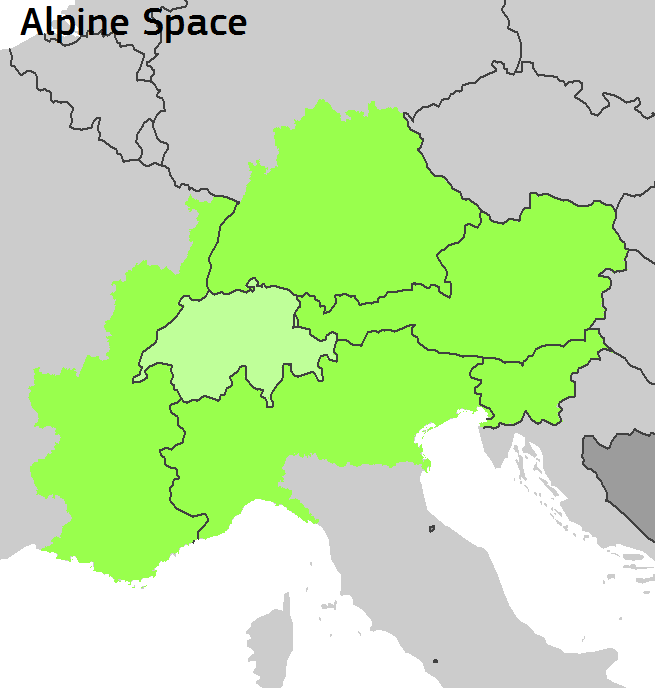
The cooperation area of the Alpine Space programme covers the Alps and their surrounding lowlands, connecting very distinct regions that include the whole area of Switzerland, Austria, Liechtenstein and Slovenia, western parts of France, southern parts of Germany and northern regions of Italy. The cooperation area of the 2021-2027 Interreg Programme embraces the whole area of 2014-2020 Interreg programme with additional seven regions from Germany. A map comparing the old and new borders can be seen here.
Why climate change adaptation matters in the Alpine Space
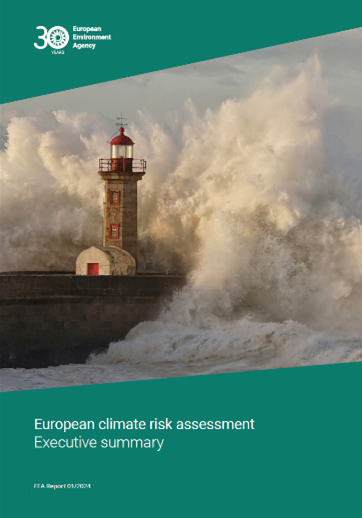
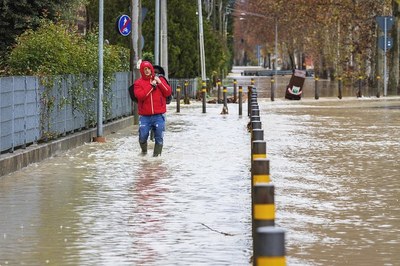
The 2024 European Climate Risk Assessment has shown that the Alpine space is affected by multiple risks due to increase in heavy precipitation, loss of snow, glacial retreat, and increase in annual mean temperatures. Policies and measures coordinated across borders need to be taken to effectively make this transnational region climate resilient.
Policy framework
1. Transnational cooperation programme
2. Macro-region strategies
3. International conventions and other cooperation initiatives
4. Adaptation strategies and plans
Explore further












Language preference detected
Do you want to see the page translated into ?
Exclusion of liability
This translation is generated by eTranslation, a machine translation tool provided by the European Commission.
Exclusion of liability
This translation is generated by eTranslation, a machine translation tool provided by the European Commission.