All official European Union website addresses are in the europa.eu domain.
See all EU institutions and bodies
An official website of the European Union | How do you know?
Environmental information systems
EN


Key messages
- In 2021-2027, the specificities of the Outermost regions are recognised through the EU funded Interreg Programme (Strand D), which supports cooperation with neighbouring countries and territories.
- The Caribbean Community Climate Change Centre represents a reference point for research on climate change impacts and adaptation strategies in the region. The centre provides information for decision makers and practitioners through a Clearinghouse Search Tool.
Geographic scope
The EU includes 22 overseas territories linked to five Member States (France, the Netherlands, Denmark, Spain and Portugal).
Nine of them are classified as Outermost Regions (ORs) and form an integral part of the EU. They comprise: three French overseas departments (Martinique, Guadeloupe and French Guyana) and one French overseas community in the Caribbean (Saint-Martin); the French overseas departments of Mayotte and Réunion in the Indian Ocean; two Portuguese autonomous regions (Madeira and the Azores) and one Spanish autonomous community (the Canary Islands) in the Atlantic.
The remaining 13 Overseas Countries and Territories (OCTs) enjoy a special ‘associate’ status and are linked to Denmark, France, and the Netherlands. These territories are constitutionally linked to the parent Member State, but are not part of the single market and must comply with the obligations on trade imposed on third countries. Council Decision (EU) 2021/1764 and Council Decision 2013/755/EU detail EU’s association relations with OCTs for the 2021-2027 and 2014-2020 periods respectively.
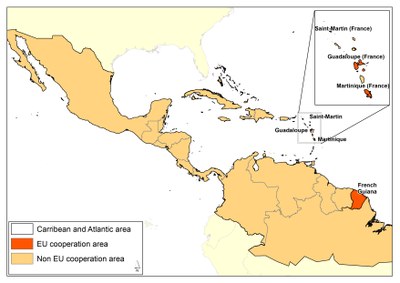
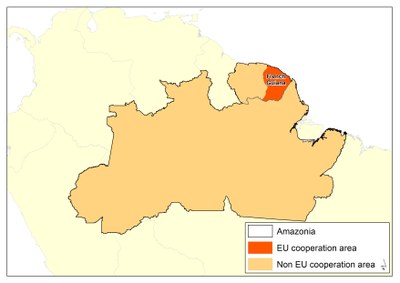
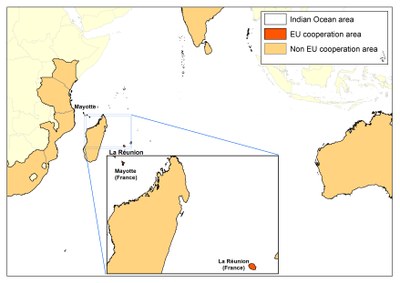
map source: ETC/CCA 2018
Why climate change adaptation matters in the Adriatic-Ionian region
EU outermost regions (EU OMRs) are comprised of islands and coastal regions in subtropical and tropical zones (French Guiana, Martinique, Guadeloupe, Saint Martin, La Réunion, Mayotte, Canary Islands, Madeira and the Azores). Due to their remote locations, weaker infrastructure and economic vulnerability, urgent action is needed to help them cope with tropical cyclones, sea level rise, marine heatwaves, and droughts and wildfires. These risks are in addition to those affecting mainland regions of the EU. Policies and measures coordinated across borders need to be taken to effectively make this transnational region climate resilient.
Policy framework
1. Transnational cooperation programme
2. Macro-region strategies
3. International conventions and other cooperation initiatives
4. Adaptation strategies and plans
Explore further










Language preference detected
Do you want to see the page translated into ?
Exclusion of liability
This translation is generated by eTranslation, a machine translation tool provided by the European Commission.
Exclusion of liability
This translation is generated by eTranslation, a machine translation tool provided by the European Commission.