All official European Union website addresses are in the europa.eu domain.
See all EU institutions and bodies
An official website of the European Union | How do you know?
Environmental information systems
EN


A broad range of organisations and co-operative programs are active on different governance levels of climate change adaptation. Climate change adaptation requires coordinated action across these governance levels. Climate-ADAPT provides an overview of the actors, organisations, networks and institutions shaping climate change adaptation policy, knowledge, implementation and learning at global, European and transnational level, helping practitioners and policymakers connect, collaborate and accelerate climate resilience.
Information on organisations that operate on national, regional and local levels can be found per country on the national adaptation pages (Country profiles) of Climate-ADAPT.
Key messages
- Climate change adaptation is inherently a multi-level governance challenge. The IPCC 6th Assessment report (AR6, 2023) highlights that effective climate change adaptation depends on coordinated action across local, regional, national, European and global governance levels, supported by inclusive governance, integrated policy frameworks and strong institutional capacity.
- The European Climate Risk Assessment (EUCRA) reinforces this message, concluding that Europe’s most pressing climate risks require urgent and coordinated action across sectors and governance levels. Effective climate change adaptation depends not only on sound climate science, but also on clear governance arrangements, well-defined responsibilities, sustained collaboration and the ability to translate knowledge into implementation.
- Climate-ADAPT contributes to this collaborative governance landscape by connecting policymakers, practitioners, researchers, and knowledge providers across Europe. Developed jointly by the European Environment Agency (EEA) and the European Commission, the platform supports knowledge exchange, peer learning and the dissemination of evidence, good practices, tools and policy guidance.
- The EEA works closely with its partners in the European Environment Information and Observation Network (Eionet) and numerous European institutions, research organisations and thematic networks to strengthen the knowledge base for climate change adaptation and resilience. Beyond Europe, Climate-ADAPT collaborates with international partners, including the Asia-Pacific Climate Change Adaptation Information Platform (AP-PLAT), to exchanges experiences and strengthen climate change adaptation knowledge worldwide.
- Recent EEA analysis also shows that successful adaptation implementation, particularly at regional and local level, depends on strong institutional support, national guidance and collaboration between authorities. Networks such as the European Urban Resilience Forum and the EU Urban Agenda's City-to-city exchanges demonstrate the value of peer learning, enabling practitioners to share experience, build capacity and accelerate implementation.
- The Climate-ADAPT newsletter is an effective means for all organisations in Europe to share knowledge for the peer-to-peer learning on adaptation.
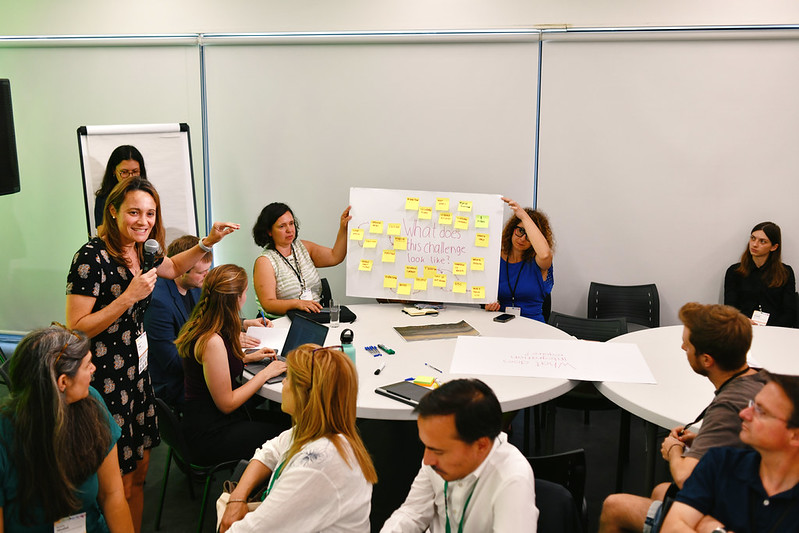
EURESFO 2026, City of Guimãraes/ICLEI Europe
Why Climate-ADAPT matters for climate change adaptation
Climate change adaptation cannot be achieved by individual organisations acting alone. Effective adaptation requires collaboration across sectors, disciplines and governance levels. Climate-ADAPT supports this collaboration by connecting the European adaptation community, facilitating knowledge exchange and showcasing practical solutions, tools and state-of-the-art practices. By strengthening networks and making adaptation knowledge more accessible, the platform helps policymakers and practitioners learn from one another, identify partners, support cross-border cooperation and accelerate the implementation of climate resilience across Europe.
Explore organizations and networks
1. Global
2. European
3. Transnational level in Europe
4. National, regional and local level in Europe
5. Adaptation in sectors
6. Knowledge sharing initiatives
Explore further




Language preference detected
Do you want to see the page translated into ?
Exclusion of liability
This translation is generated by eTranslation, a machine translation tool provided by the European Commission.
Exclusion of liability
This translation is generated by eTranslation, a machine translation tool provided by the European Commission.